 Fin's Fish Guide

The Tricorn batfish (Zalieutes mcgintyi) is a saltwater fish of the family Ogcocephalidae that grows up to 10 cm.
Description
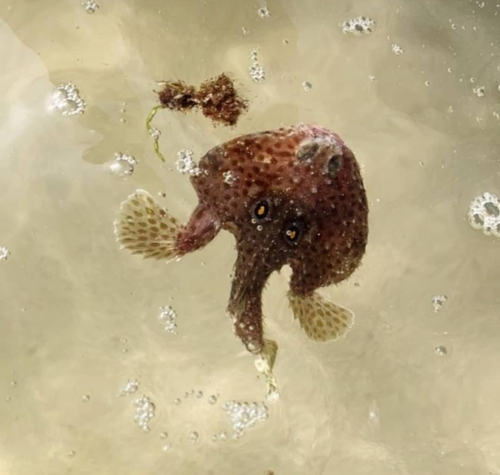
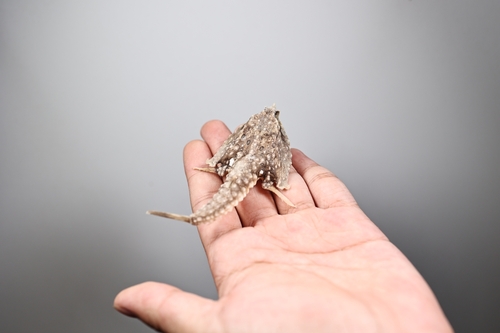
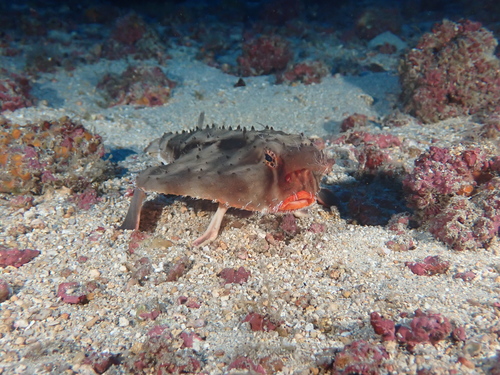
The tricorn batfish is a small bottom fish of the batfish family (Ogcocephalidae) from the western Atlantic and Gulf of Mexico. The species grows to about 10 cm and has a flattened, triangular body with arm-like pectoral and pelvic fins with which it 'walks' over the bottom rather than swimming. It lives offshore, usually at depths between 90 and 180 metres. Beneath the snout is a small, retractable lure to attract prey. As a slow bottom hunter it feeds on small crustaceans and small fishes. Owing to its camouflaged, slow-moving habits it is little noticed. The species is harmless to humans.
Frequently asked questions
How do you recognise the Tricorn batfish?
The Tricorn batfish has a flattened, disc-shaped body, is mainly brown and shows a spots pattern. Triangular, flattened body; 'walks' on arm-like fins and lures prey with a small lure organ.
Where does the Tricorn batfish live?
The Tricorn batfish lives in the sea (marine waters) and is mostly found around sand or mud bottom. Western Atlantic and Gulf of Mexico; offshore bottoms at 90-180 m.
How big does the Tricorn batfish get?
The Tricorn batfish grows to a maximum of about 10 cm.
Is the Tricorn batfish dangerous to humans?
No, the Tricorn batfish is harmless to humans. None required: this species is harmless to humans.
Is the Tricorn batfish edible?
The Tricorn batfish is not usually eaten.
More photos


Want the complete picture on the Tricorn batfish?
Point your camera at the fish and Fin names the species in seconds. Free, and the Tricorn batfish is one of 12,519 species in the app.
All data
Identification
Appearance
Habitat & distribution
Behaviour & biology
For anglers
Safety
Status & sources
Same genus Zalieutes
More from the family Ogcocephalidae





Want the complete picture on the Tricorn batfish?
Point your camera at the fish and Fin names the species in seconds. Free, and the Tricorn batfish is one of 12,519 species in the app.