 Fin's Fish Guide
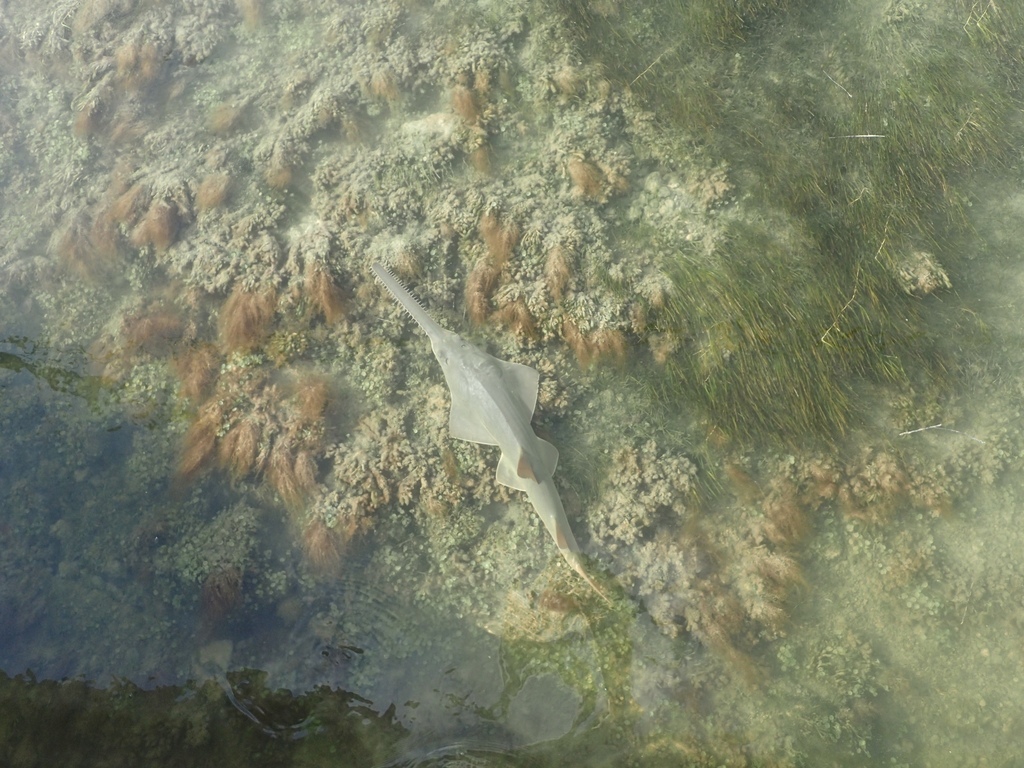
The Smalltooth sawfish (Pristis pectinata) is a fish that lives in both fresh and salt water of the family Pristidae that grows up to 760 cm.
Tropical and subtropical Atlantic Ocean on both sides, in shallow coastal waters, estuaries and mangroves; tolerates brackish and fresh water and enters rivers. Today reduced to a fraction of its range.
Description
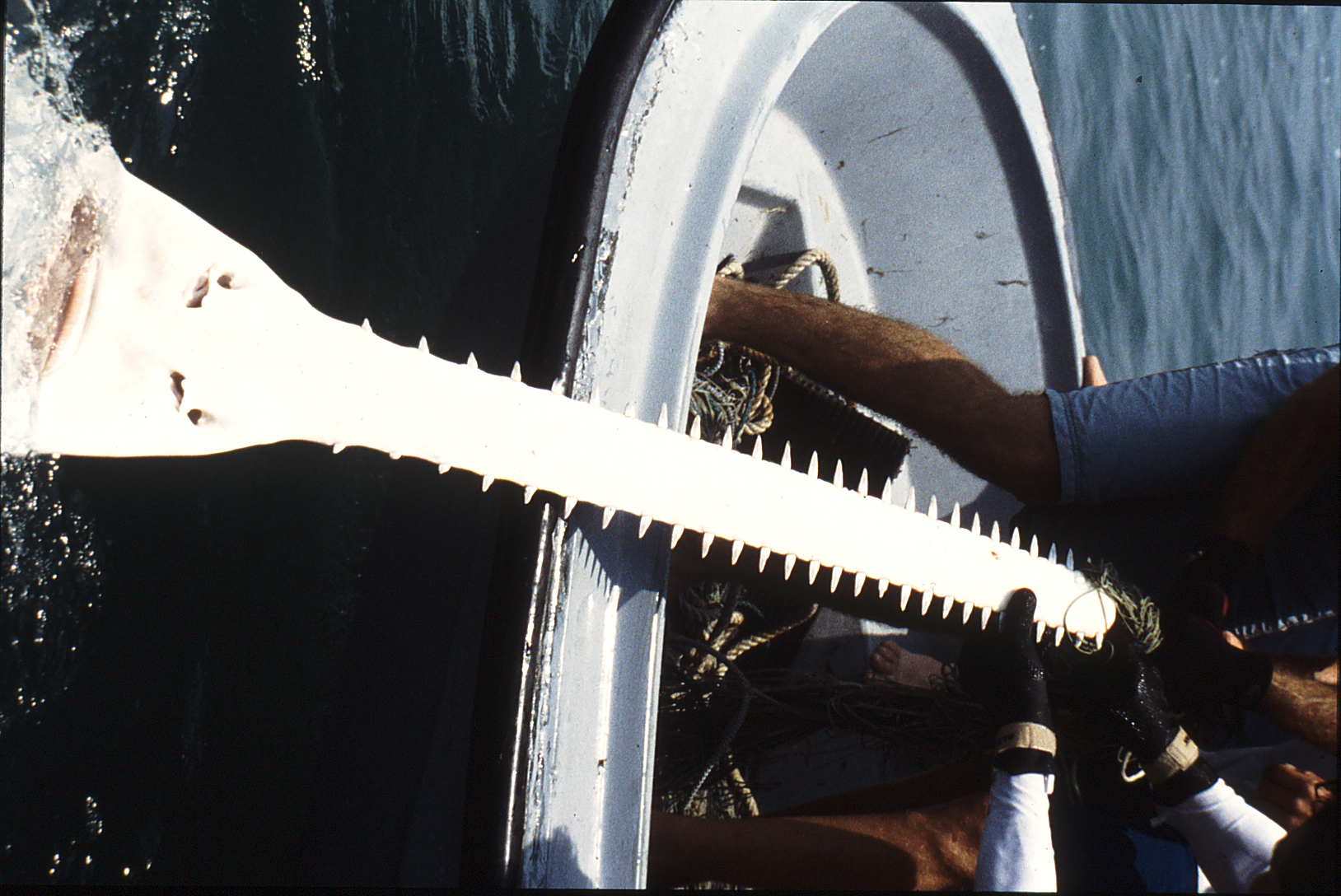
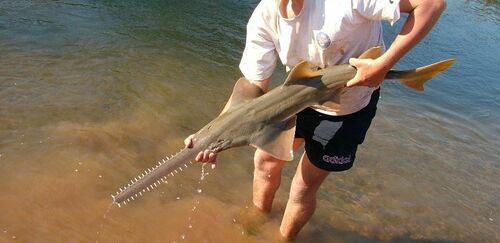
The smalltooth sawfish is a large, shark-like ray of the family Pristidae (sawfishes) that can reach a total length of over 7 metres. The body resembles a shark's, but the gill slits are on the underside, revealing that it is a ray. Characteristic is the long, flat snout (rostrum) set with pairs of even teeth, which serves as a saw: with it the animal slashes through schooling fish and rakes the bottom for prey; the saw is also a sensory organ that detects electrical signals. The species lives in shallow coastal waters, estuaries and mangroves of the tropical Atlantic and enters rivers. Through bycatch and habitat loss it has collapsed worldwide and is assessed as Critically Endangered (CR).
Frequently asked questions
How do you recognise the Smalltooth sawfish?
The Smalltooth sawfish has a torpedo-shaped body, is mainly brown and shows a plain pattern. Shark-like ray with a long, flat 'saw' (rostrum) set with pairs of teeth, with which it strikes into shoals of fish and stirs up the bottom.
Where does the Smalltooth sawfish live?
The Smalltooth sawfish lives in both fresh and salt water and is mostly found around sand or mud bottom. Tropical and subtropical Atlantic Ocean on both sides, in shallow coastal waters, estuaries and mangroves; tolerates brackish and fresh water and enters rivers. Today reduced to a fraction of its range.
How big does the Smalltooth sawfish get?
The Smalltooth sawfish grows to a maximum of about 760 cm. On average the species is around 550 cm.
Is the Smalltooth sawfish dangerous to humans?
The Smalltooth sawfish can cause injury; handle it with care. Not venomous, but the toothed saw can inflict serious cuts when the animal thrashes: keep well clear of a hooked or stranded sawfish and do not touch the rostrum.
Is the Smalltooth sawfish edible?
The Smalltooth sawfish is not usually eaten.
More photos

Easily confused with
These species look like the Smalltooth sawfish and live in the same waters.

Want the complete picture on the Smalltooth sawfish?
Point your camera at the fish and Fin names the species in seconds. Free, and the Smalltooth sawfish is one of 12,519 species in the app.
All data
Identification
Appearance
Habitat & distribution
Behaviour & biology
For anglers
Safety
Status & sources
Same genus Pristis


More from the family Pristidae

Want the complete picture on the Smalltooth sawfish?
Point your camera at the fish and Fin names the species in seconds. Free, and the Smalltooth sawfish is one of 12,519 species in the app.