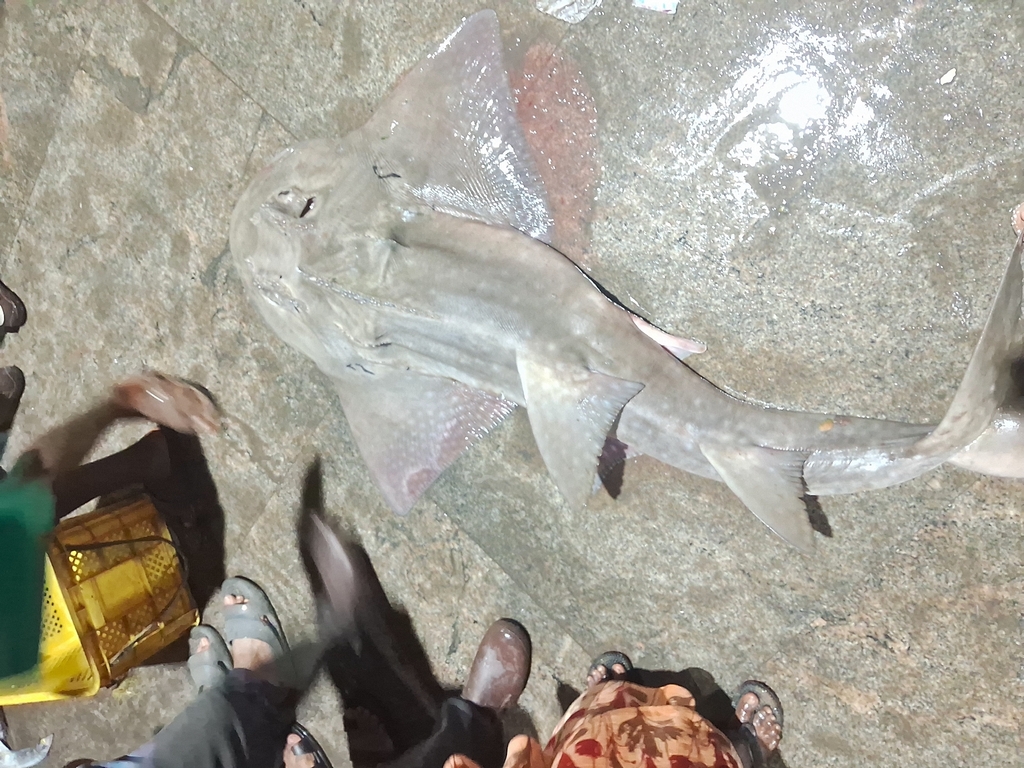
The Bowmouth guitarfish (Rhina ancylostoma) is a saltwater fish of the family Rhinidae that grows up to 270 cm.
Description
The bowmouth guitarfish, also called 'shark ray', is a striking cartilaginous fish of the family Rhinidae from the Indo-West Pacific. The species can reach about 270 cm and has a broad, rounded head, thorny ridges above the eyes and on the back, and a muscular, shark-like tail; the body is grey-blue with white spots. It lives on sand and mud bottoms of coastal waters and reefs and crushes crustaceans, molluscs and small fishes with its flat grinding plates. It is livebearing. Through heavy fishing for its fins and meat the species is critically endangered (CR).
Frequently asked questions
How do you recognise the Bowmouth guitarfish?
The Bowmouth guitarfish has an irregular in shape body, is mainly blue and shows a spots pattern.
Where does the Bowmouth guitarfish live?
The Bowmouth guitarfish lives in the sea (marine waters) and is mostly found around sand or mud bottom.
How big does the Bowmouth guitarfish get?
The Bowmouth guitarfish grows to a maximum of about 270 cm. On average the species is around 150 cm.
Is the Bowmouth guitarfish dangerous to humans?
No, the Bowmouth guitarfish is harmless to humans.
Is the Bowmouth guitarfish edible?
Yes, the Bowmouth guitarfish is commonly eaten.
Download Fin's Fish Guide
Identify fish in seconds, log your catches and dives. Join the TestFlight beta.
All data
Identification
Appearance
Habitat & distribution
Behaviour & biology
Safety
Status & sources
More from the family Rhinidae
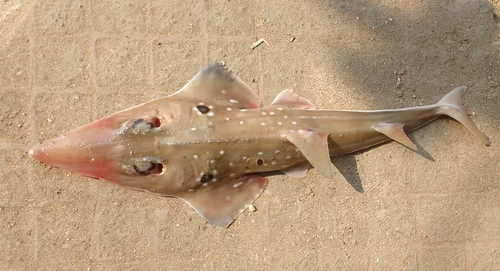
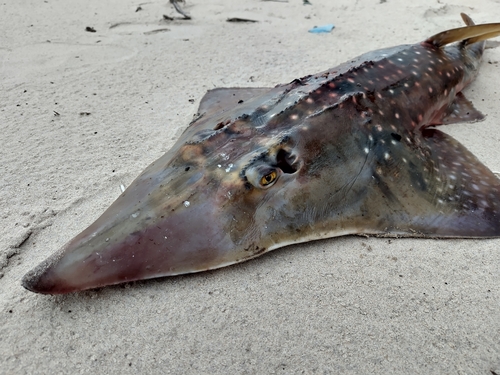
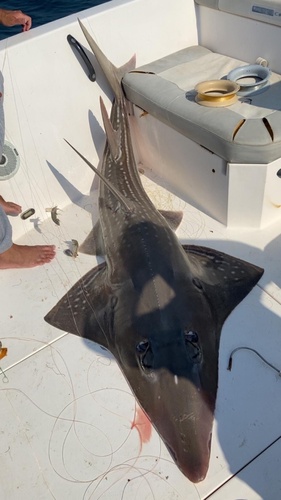
Download Fin's Fish Guide
Identify fish in seconds, log your catches and dives. Join the TestFlight beta.