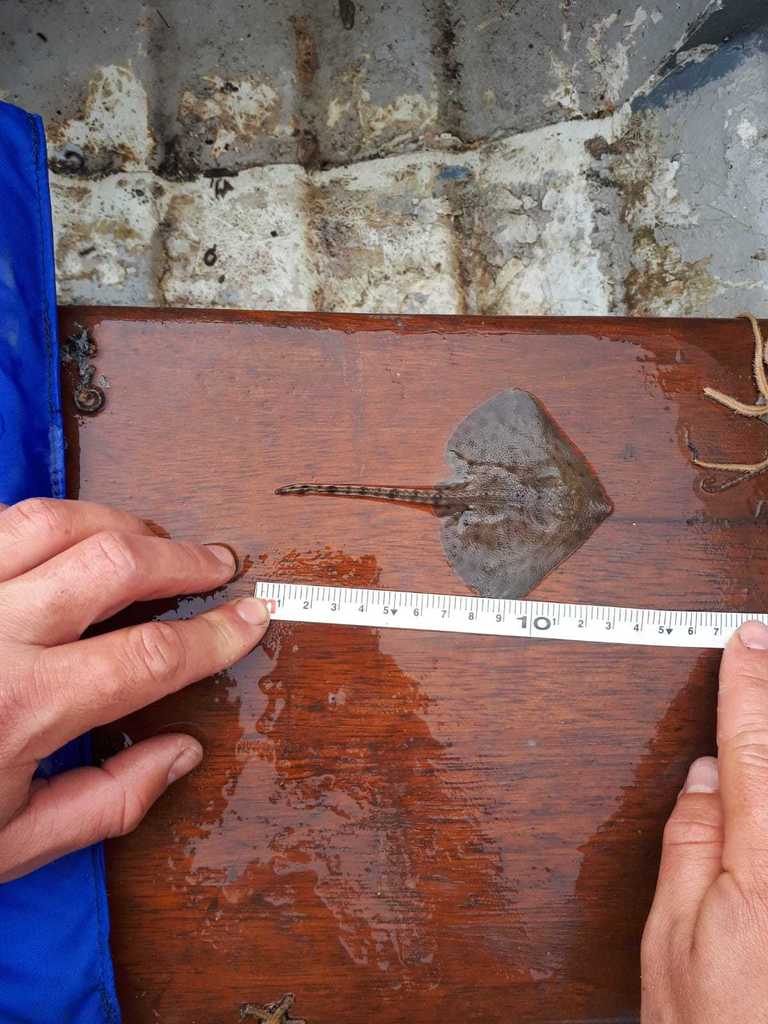
The Thornback ray (Raja clavata) is a saltwater fish of the family Rajidae that grows up to 105 cm.
Description
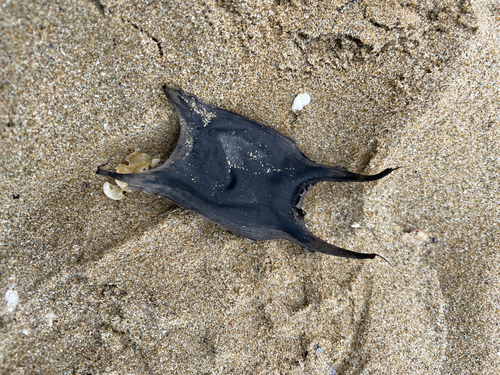
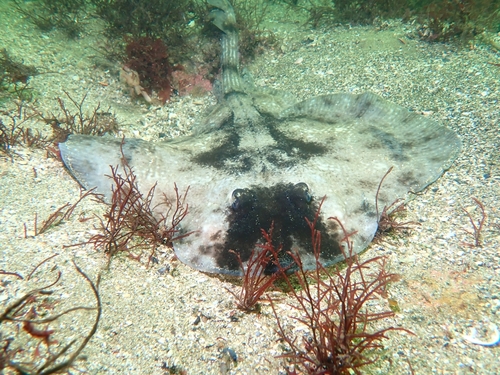
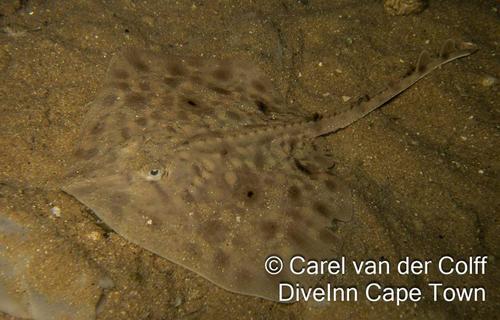
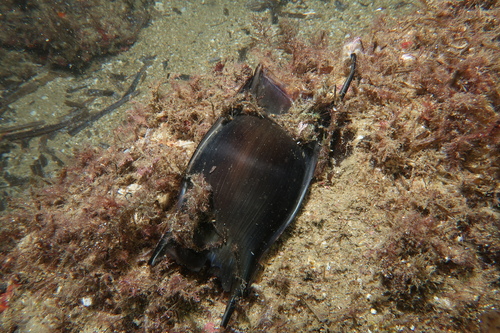
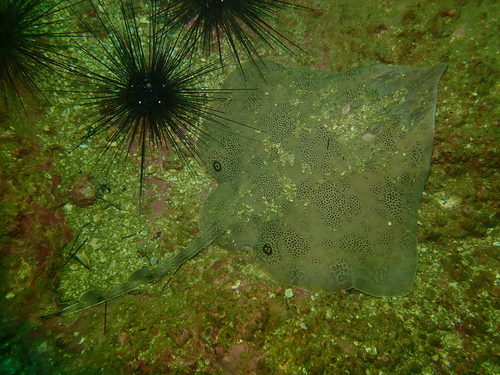
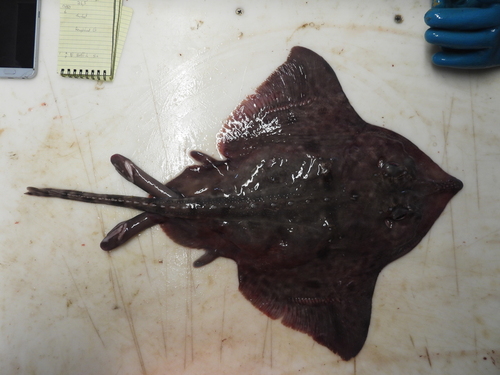
The thornback ray is a flat cartilaginous fish of the family Rajidae reaching a wingspan of about 1 metre. The diamond-shaped body, formed by the pectoral fins fused to the head, is brownish with light and dark spots giving good camouflage on the bottom. Characteristic are the rows of curved thorns on the back and tail and the large 'bucklers' on thickened skin plates, from which the species takes its name. It lives on sand and mud bottoms of the eastern Atlantic, the North Sea and the Mediterranean, from shallow water to hundreds of metres. On the bottom it hunts crabs, shrimps, shellfish and small fish. It lays eggs in horny capsules. Due to fishing it is assessed as Near Threatened (NT).
Frequently asked questions
How do you recognise the Thornback ray?
The Thornback ray has an irregular in shape body, is mainly brown and shows a spots pattern.
Where does the Thornback ray live?
The Thornback ray lives in the sea (marine waters) and is mostly found around sand or mud bottom.
How big does the Thornback ray get?
The Thornback ray grows to a maximum of about 105 cm. On average the species is around 85 cm.
Is the Thornback ray dangerous to humans?
No, the Thornback ray is harmless to humans.
Is the Thornback ray edible?
Yes, the Thornback ray is commonly eaten.
Download Fin's Fish Guide
Identify fish in seconds, log your catches and dives. Join the TestFlight beta.
All data
Identification
Appearance
Habitat & distribution
Behaviour & biology
For anglers
Safety
Status & sources
Same genus Raja
More from the family Rajidae
Download Fin's Fish Guide
Identify fish in seconds, log your catches and dives. Join the TestFlight beta.