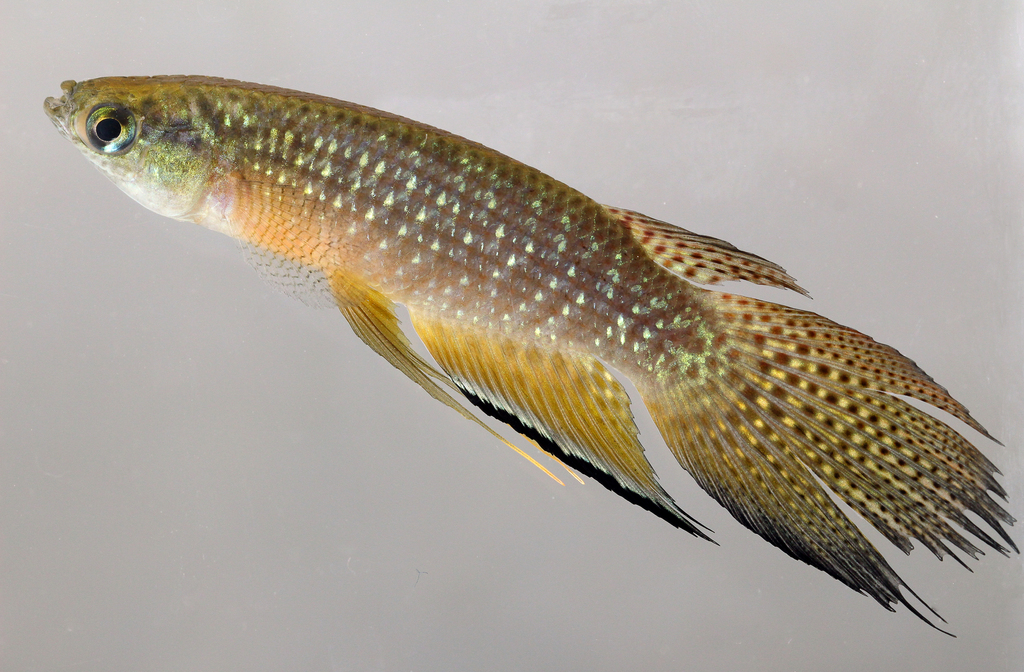
The Featherfin panchax (Pterolebias longipinnis) is a freshwater fish of the family Rivulidae that grows up to 12 cm.
Description
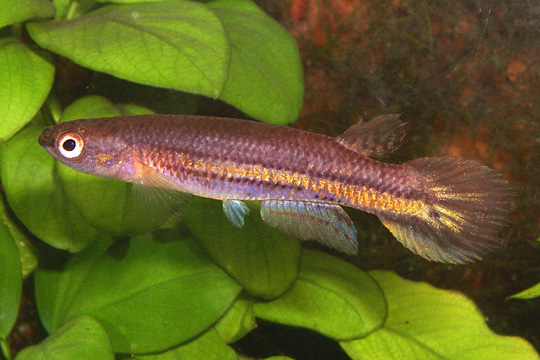
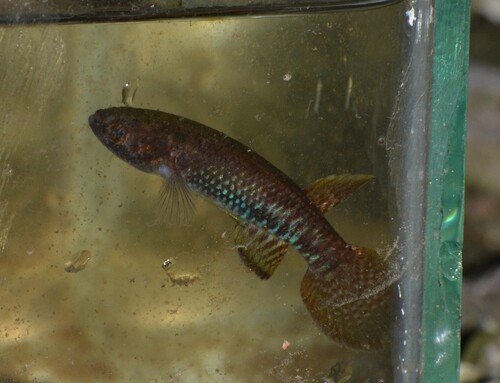
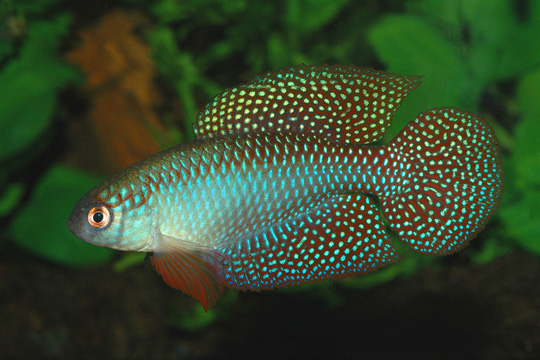
The featherfin panchax is a short-lived killifish from fresh water of the Amazon and La Plata basins of South America. The species grows to about 12 cm; males have strongly flared, feather-like dorsal, anal and tail fins and handsome markings, while females are plainer. It is an annual fish: the eggs survive the dry season in the mud until the rains refill the pools. It feeds on small invertebrates and insect larvae. The fish appears in the aquarium hobby. The IUCN has not evaluated the species.
Frequently asked questions
How do you recognise the Featherfin panchax?
The Featherfin panchax has a torpedo-shaped body, is mainly brown and shows a spots pattern.
Where does the Featherfin panchax live?
The Featherfin panchax lives in fresh water and is mostly found around mixed bottom.
How big does the Featherfin panchax get?
The Featherfin panchax grows to a maximum of about 12 cm.
Is the Featherfin panchax dangerous to humans?
No, the Featherfin panchax is harmless to humans.
Is the Featherfin panchax edible?
The Featherfin panchax is not usually eaten.
Download Fin's Fish Guide
Identify fish in seconds, log your catches and dives. Join the TestFlight beta.
All data
Identification
Appearance
Habitat & distribution
Behaviour & biology
For anglers
Safety
Status & sources
More from the family Rivulidae


Download Fin's Fish Guide
Identify fish in seconds, log your catches and dives. Join the TestFlight beta.