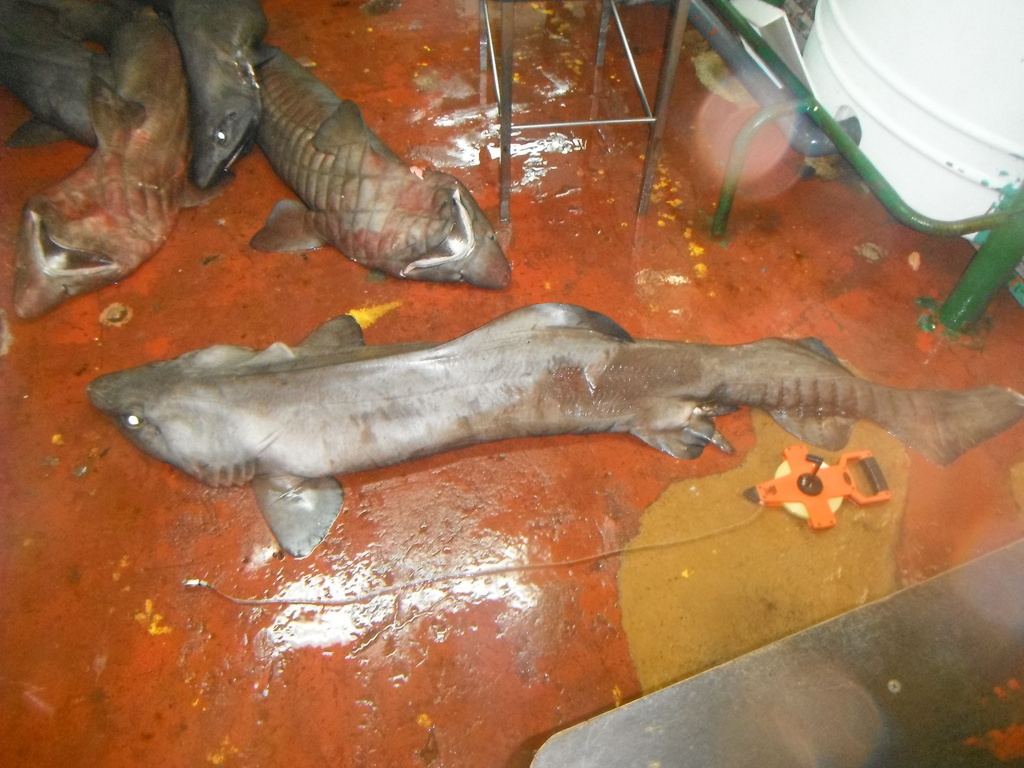
The False catshark (Pseudotriakis microdon) is a saltwater fish of the family Pseudotriakidae that grows up to 269 cm.
Description
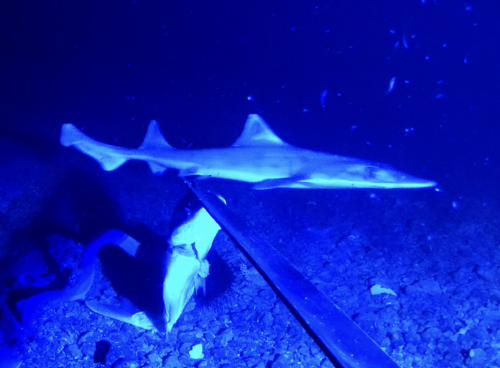
The false catshark is a large, flabby deep-sea shark of the family Pseudotriakidae reaching about 2.7 metres. Characteristic is the strikingly long, low first dorsal fin, running like a crest along much of the back; the mouth is set with numerous small teeth. The brown-black body is soft and the muscles flabby, fitting a slow swimmer that saves energy in the food-poor deep sea. The species occurs worldwide but is everywhere rare, along continental slopes and seamounts, including the eastern Atlantic around the British and Macaronesian islands, usually between two hundred and nearly two thousand metres. It eats deep-sea fish, squid, crustaceans and carrion. Reproduction is ovoviviparous with very small litters, the embryos feeding on yolk.
Frequently asked questions
How do you recognise the False catshark?
The False catshark has an elongate, eel-like body, is mainly brown and shows a plain pattern.
Where does the False catshark live?
The False catshark lives in the sea (marine waters) and is mostly found around sand or mud bottom.
How big does the False catshark get?
The False catshark grows to a maximum of about 269 cm.
Is the False catshark dangerous to humans?
No, the False catshark is harmless to humans.
Is the False catshark edible?
The False catshark is not usually eaten.
Download Fin's Fish Guide
Identify fish in seconds, log your catches and dives. Join the TestFlight beta.
All data
Identification
Appearance
Habitat & distribution
Behaviour & biology
For anglers
Safety
Status & sources
More from the family Pseudotriakidae
Download Fin's Fish Guide
Identify fish in seconds, log your catches and dives. Join the TestFlight beta.