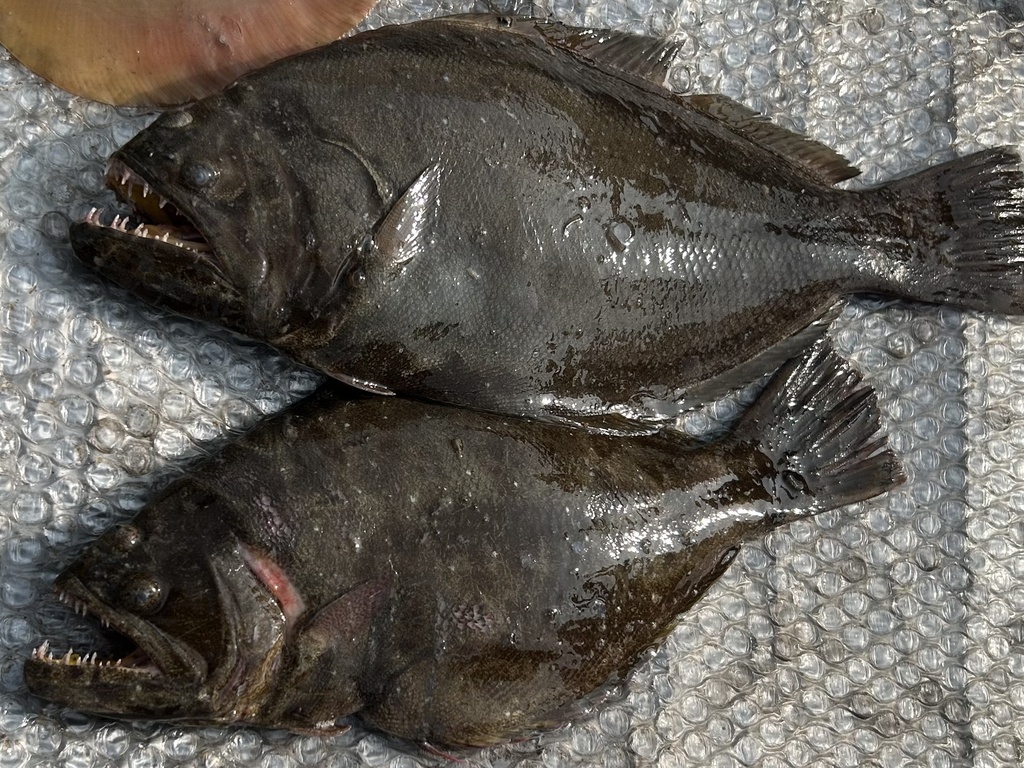
The Indian halibut (Psettodes erumei) is a saltwater fish of the family Psettodidae that grows up to 64 cm.
Description
The Indian halibut (Psettodes erumei) is a flatfish of the Indo-West Pacific, from the Red Sea and East Africa to Japan and Australia. It grows to 64 centimetres and lives on sand and mud bottoms, usually at 20-50 metres. The body is oval and flat but thicker than that of most flatfishes, and in this primitive flatfish group the eyes occur on either the left or the right side. The fish is brown or grey with four broad dark crossbars and black fin tips. It is a decided piscivore with a large mouth. The species is a valued commercial fish, sold mainly fresh.
Frequently asked questions
How do you recognise the Indian halibut?
The Indian halibut has a torpedo-shaped body, is mainly brown and shows a vertical stripes pattern.
Where does the Indian halibut live?
The Indian halibut lives in the sea (marine waters) and is mostly found around sand or mud bottom.
How big does the Indian halibut get?
The Indian halibut grows to a maximum of about 64 cm. On average the species is around 50 cm.
Is the Indian halibut dangerous to humans?
No, the Indian halibut is harmless to humans.
Is the Indian halibut edible?
Yes, the Indian halibut is commonly eaten.
Download Fin's Fish Guide
Identify fish in seconds, log your catches and dives. Join the TestFlight beta.
All data
Identification
Appearance
Habitat & distribution
Behaviour & biology
For anglers
Safety
Status & sources
Same genus Psettodes
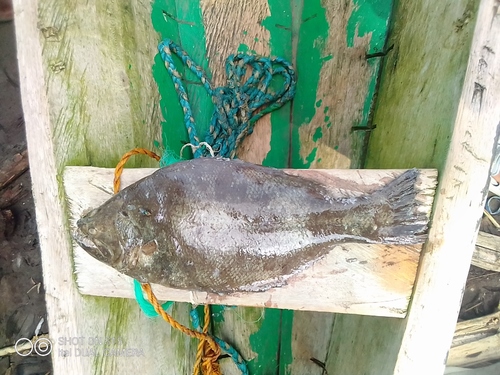
More from the family Psettodidae
Download Fin's Fish Guide
Identify fish in seconds, log your catches and dives. Join the TestFlight beta.