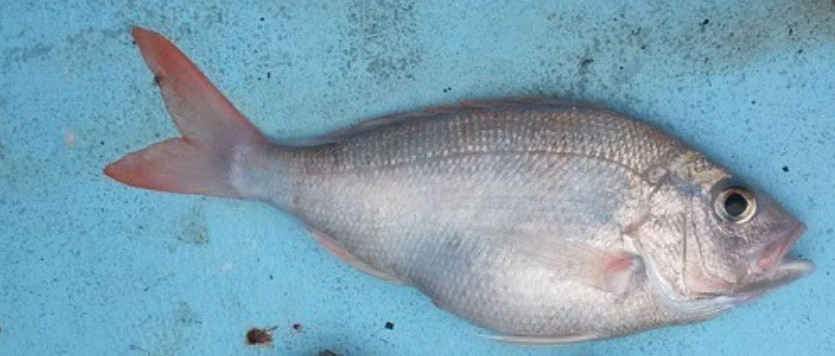
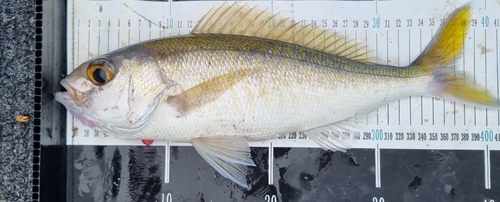
The Bigeye snapper (Pristipomoides macrophthalmus) is a saltwater fish of the family Lutjanidae that grows up to 50 cm.
Description
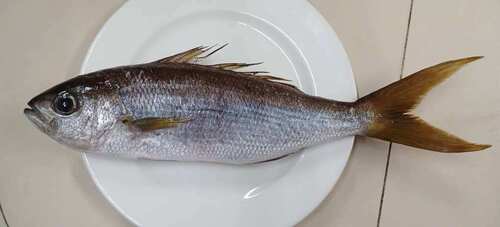
The bigeye snapper is a deep-water snapper (Lutjanidae) from the western Atlantic. The species reaches about 50 cm and has a slender, pink to silvery body with conspicuously large eyes, an adaptation to the dim deep water. Adults usually live in the deeper parts of the continental shelf near the edge of the slope, at about 110 to 550 m deep. They feed on small fishes and larger planktonic animals. The species is marketed fresh, but owing to its great depth it is caught less often than shallower snappers.
Frequently asked questions
How do you recognise the Bigeye snapper?
The Bigeye snapper has a torpedo-shaped body, is mainly red-orange and shows a plain pattern.
Where does the Bigeye snapper live?
The Bigeye snapper lives in the sea (marine waters) and is mostly found around mixed bottom.
How big does the Bigeye snapper get?
The Bigeye snapper grows to a maximum of about 50 cm. On average the species is around 30 cm.
Is the Bigeye snapper dangerous to humans?
No, the Bigeye snapper is harmless to humans.
Is the Bigeye snapper edible?
The Bigeye snapper is rarely eaten.
Download Fin's Fish Guide
Identify fish in seconds, log your catches and dives. Join the TestFlight beta.
All data
Identification
Appearance
Habitat & distribution
Behaviour & biology
For anglers
Safety
Status & sources
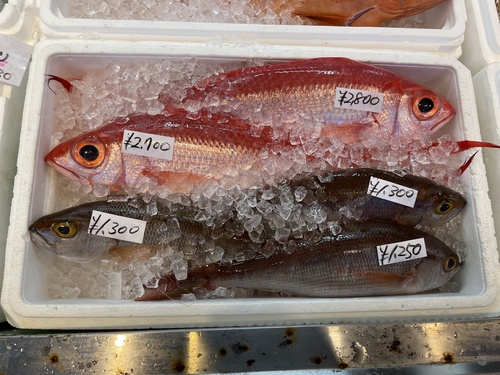
Same genus Pristipomoides

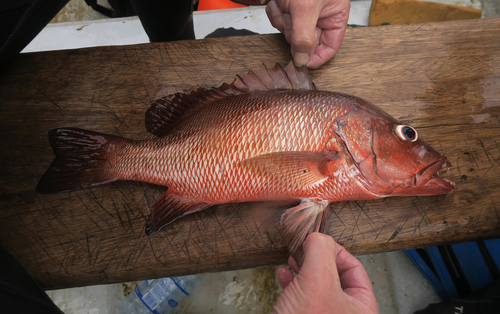
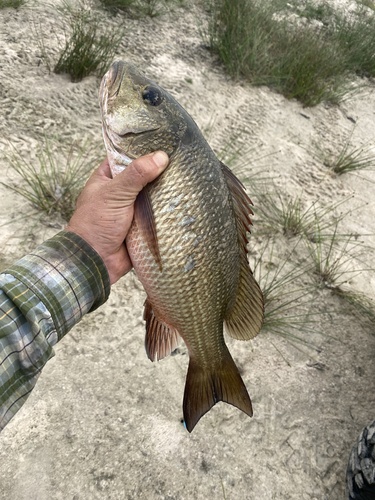
More from the family Lutjanidae

Download Fin's Fish Guide
Identify fish in seconds, log your catches and dives. Join the TestFlight beta.