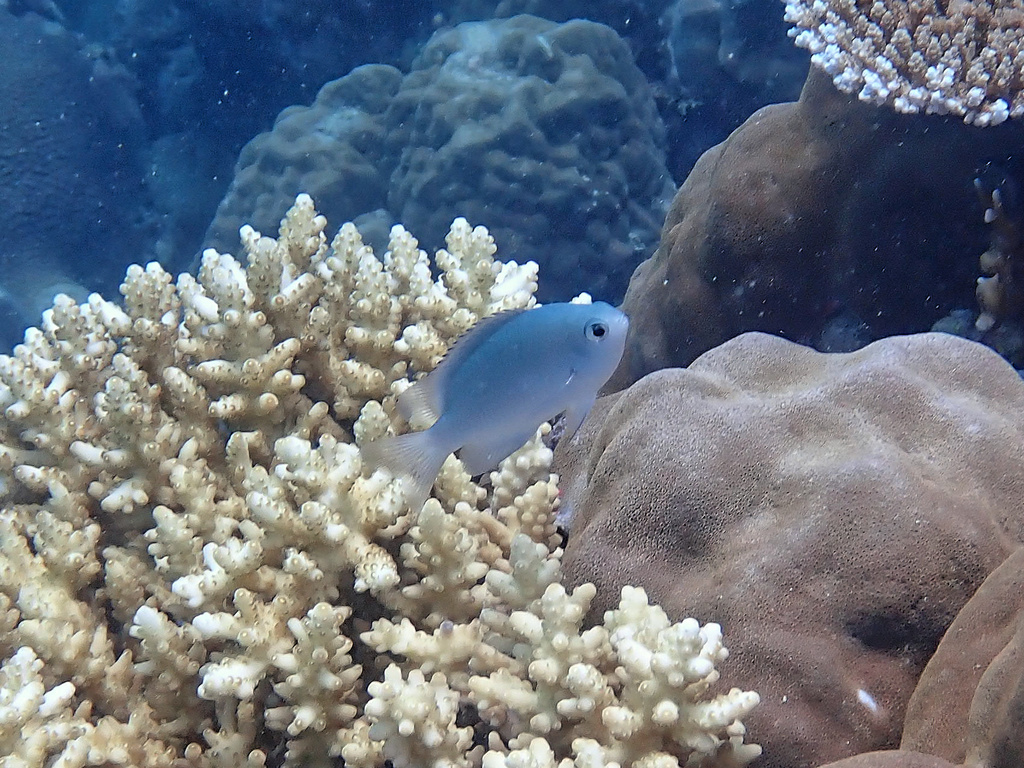
The Damselfish (Pomacentrus lepidogenys) is a saltwater fish of the family Pomacentridae that grows up to 9 cm.
Description
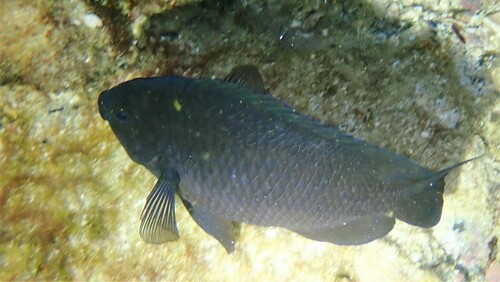
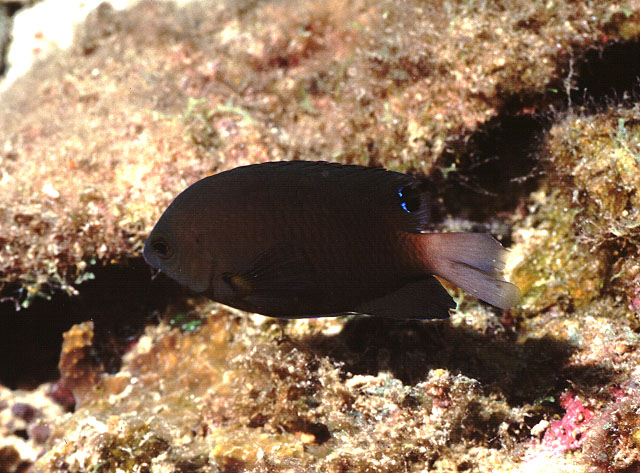
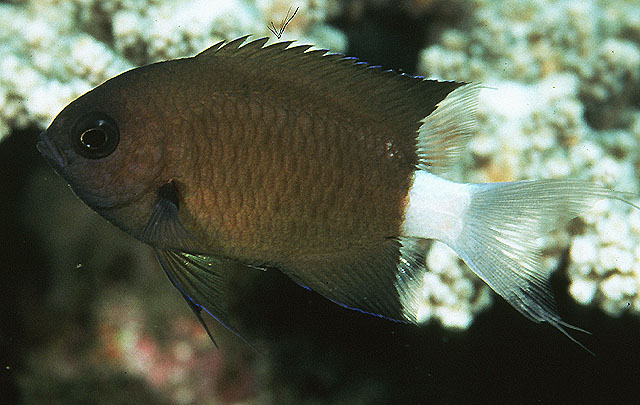
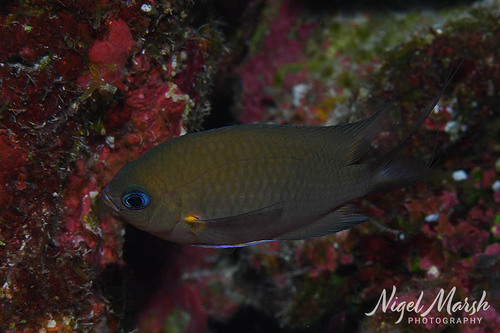
The scaly damsel is a reef fish of the family Pomacentridae from the Indo-West Pacific. The species reaches about 9 cm and has a grey-brown body with a yellowish tinge and translucent fins. Adults inhabit lagoons, reef passages and outer reef slopes, where they hover singly or in small groups just above the bottom in the water column, feeding on zooplankton. The eggs are adhesive and laid on the bottom; the male guards the brood. The IUCN assesses the species as near threatened (NT). It is a common sight on outer reefs.
Frequently asked questions
How do you recognise the Damselfish?
The Damselfish has a flattened, disc-shaped body, is mainly brown and shows a plain pattern.
Where does the Damselfish live?
The Damselfish lives in the sea (marine waters) and is mostly found around stony or rocky ground.
How big does the Damselfish get?
The Damselfish grows to a maximum of about 9 cm. On average the species is around 6 cm.
Is the Damselfish dangerous to humans?
No, the Damselfish is harmless to humans.
Is the Damselfish edible?
The Damselfish is not usually eaten.
Download Fin's Fish Guide
Identify fish in seconds, log your catches and dives. Join the TestFlight beta.
All data
Identification
Appearance
Habitat & distribution
Behaviour & biology
For anglers
Safety
Status & sources
Same genus Pomacentrus
More from the family Pomacentridae
Download Fin's Fish Guide
Identify fish in seconds, log your catches and dives. Join the TestFlight beta.