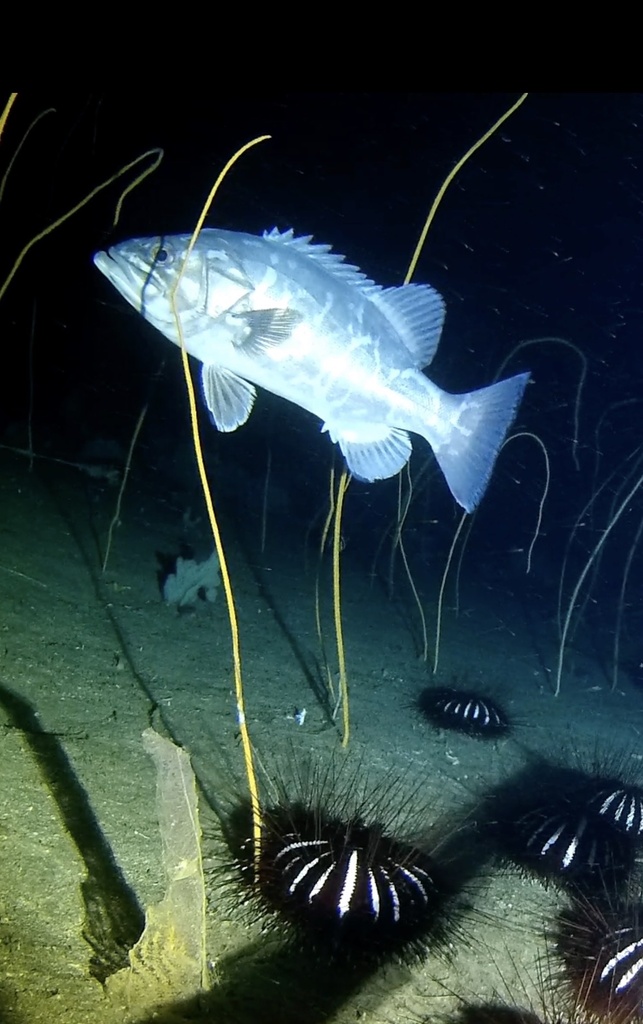
The Atlantic wreckfish (Polyprion americanus) is a saltwater fish of the family Polyprionidae that grows up to 210 cm.
Description
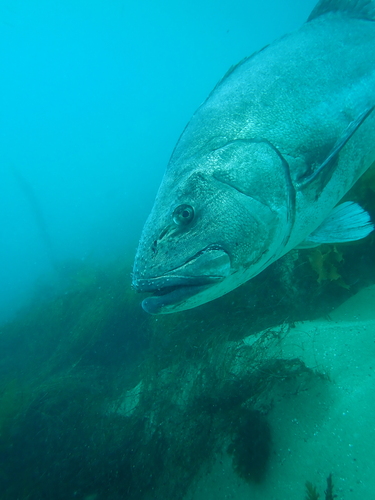
The Atlantic wreckfish is a sturdy, dark grouper relative of the family Polyprionidae that can reach about 2 metres and over a hundred kilograms, and live for decades. The stout, brown-grey body has a large head with a projecting lower jaw and a conspicuous bony ridge across the gill cover. Juveniles drift for years under floating wreckage, buoys and weed rafts at the surface, giving the species its name; adults live solitarily at greater depth near rocky bottoms, caves, wrecks and seamounts of the Atlantic and the Mediterranean. It hunts fish, squid and large crustaceans. Through deep-sea fishing and its slow growth little is known about its stock (Data Deficient).
Frequently asked questions
How do you recognise the Atlantic wreckfish?
The Atlantic wreckfish has a torpedo-shaped body, is mainly brown and shows a plain pattern.
Where does the Atlantic wreckfish live?
The Atlantic wreckfish lives in the sea (marine waters) and is mostly found around sand or mud bottom.
How big does the Atlantic wreckfish get?
The Atlantic wreckfish grows to a maximum of about 210 cm. On average the species is around 80 cm.
Is the Atlantic wreckfish dangerous to humans?
No, the Atlantic wreckfish is harmless to humans.
Is the Atlantic wreckfish edible?
Yes, the Atlantic wreckfish is commonly eaten.
Download Fin's Fish Guide
Identify fish in seconds, log your catches and dives. Join the TestFlight beta.
All data
Identification
Appearance
Habitat & distribution
Behaviour & biology
For anglers
Safety
Status & sources
More from the family Polyprionidae
Download Fin's Fish Guide
Identify fish in seconds, log your catches and dives. Join the TestFlight beta.