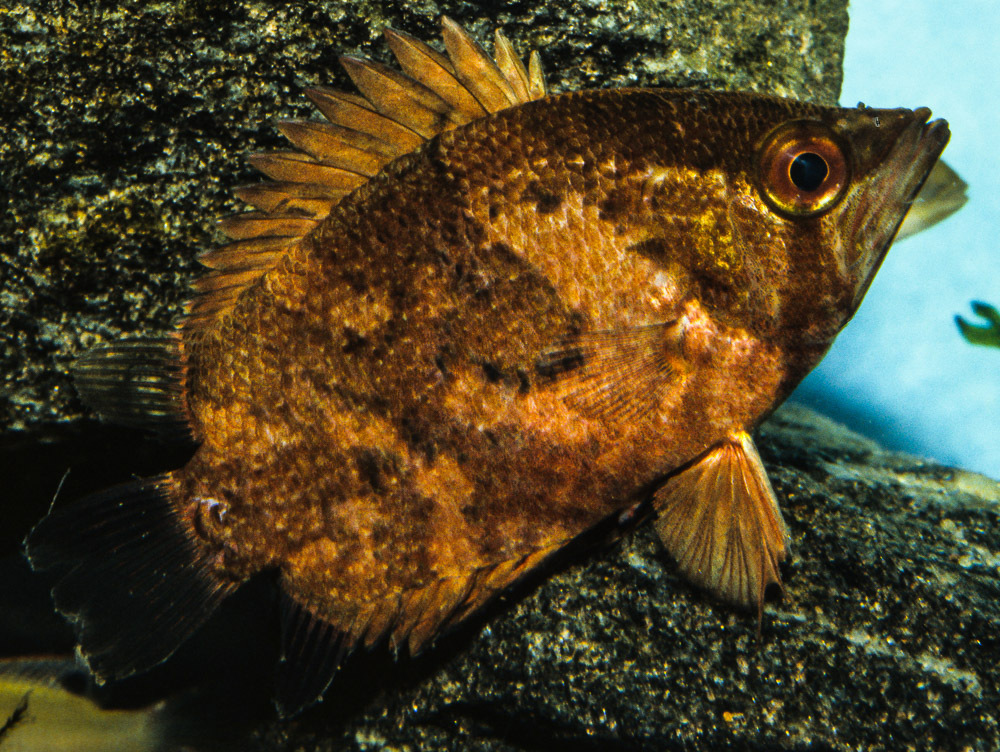
The African leaffish (Polycentropsis abbreviata) is a freshwater fish of the family Nandidae that grows up to 7 cm.
Description
The African leaffish is a small predatory fish of the family Nandidae from West African rainforests. The species grows to only about 7 cm and has a deep, laterally compressed, brown mottled body that strongly resembles a dead leaf. With this camouflage and a drifting, seemingly lifeless posture it stalks prey among floating leaves, then sucks it in at once with a strongly protrusible mouth. It hunts small fishes and invertebrates. The African leaffish inhabits quiet, shaded forest waters and sometimes builds a foam nest. It is harmless to humans.
Frequently asked questions
How do you recognise the African leaffish?
The African leaffish has a flattened, disc-shaped body, is mainly brown and shows a marbled pattern.
Where does the African leaffish live?
The African leaffish lives in fresh water and is mostly found around mixed bottom.
How big does the African leaffish get?
The African leaffish grows to a maximum of about 7 cm.
Is the African leaffish dangerous to humans?
No, the African leaffish is harmless to humans.
Is the African leaffish edible?
The African leaffish is not usually eaten.
Download Fin's Fish Guide
Identify fish in seconds, log your catches and dives. Join the TestFlight beta.
All data
Identification
Appearance
Habitat & distribution
Behaviour & biology
For anglers
Safety
Status & sources
More from the family Nandidae

Download Fin's Fish Guide
Identify fish in seconds, log your catches and dives. Join the TestFlight beta.