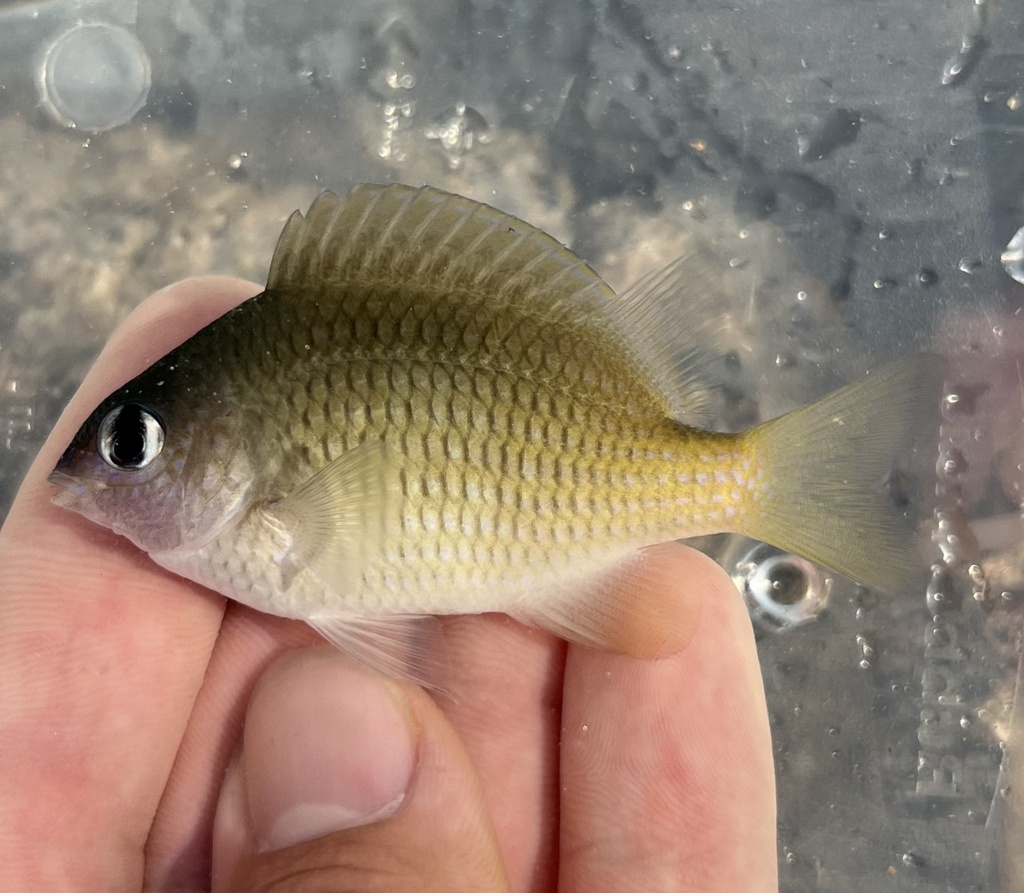
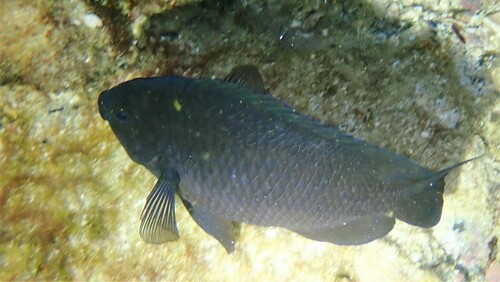
The Brighteye damsel (Plectroglyphidodon imparipennis) is a saltwater fish of the family Pomacentridae that grows up to 6 cm.
Description
The brighteye damselfish is a small reef fish from the Indo-Pacific, ranging from East Africa to Hawaii and the Pitcairn Islands, north to Japan. The species grows to about 6 cm and has a pale body with bright eyes. It lives exclusively in the surge zone of seaward reefs, close to small holes and sea-urchin furrows into which it darts when threatened. The fish is active by day and feeds on benthic algae and small invertebrates. The eggs are laid on the substrate and guarded and aerated by the male. The IUCN assesses the species as Least Concern (LC).
Frequently asked questions
How do you recognise the Brighteye damsel?
The Brighteye damsel has a torpedo-shaped body, is mainly white and shows a plain pattern.
Where does the Brighteye damsel live?
The Brighteye damsel lives in the sea (marine waters) and is mostly found around stony or rocky ground.
How big does the Brighteye damsel get?
The Brighteye damsel grows to a maximum of about 6 cm.
Is the Brighteye damsel dangerous to humans?
No, the Brighteye damsel is harmless to humans.
Is the Brighteye damsel edible?
The Brighteye damsel is not usually eaten.
Download Fin's Fish Guide
Identify fish in seconds, log your catches and dives. Join the TestFlight beta.
All data
Identification
Appearance
Habitat & distribution
Behaviour & biology
For anglers
Safety
Status & sources
Same genus Plectroglyphidodon
More from the family Pomacentridae
Download Fin's Fish Guide
Identify fish in seconds, log your catches and dives. Join the TestFlight beta.