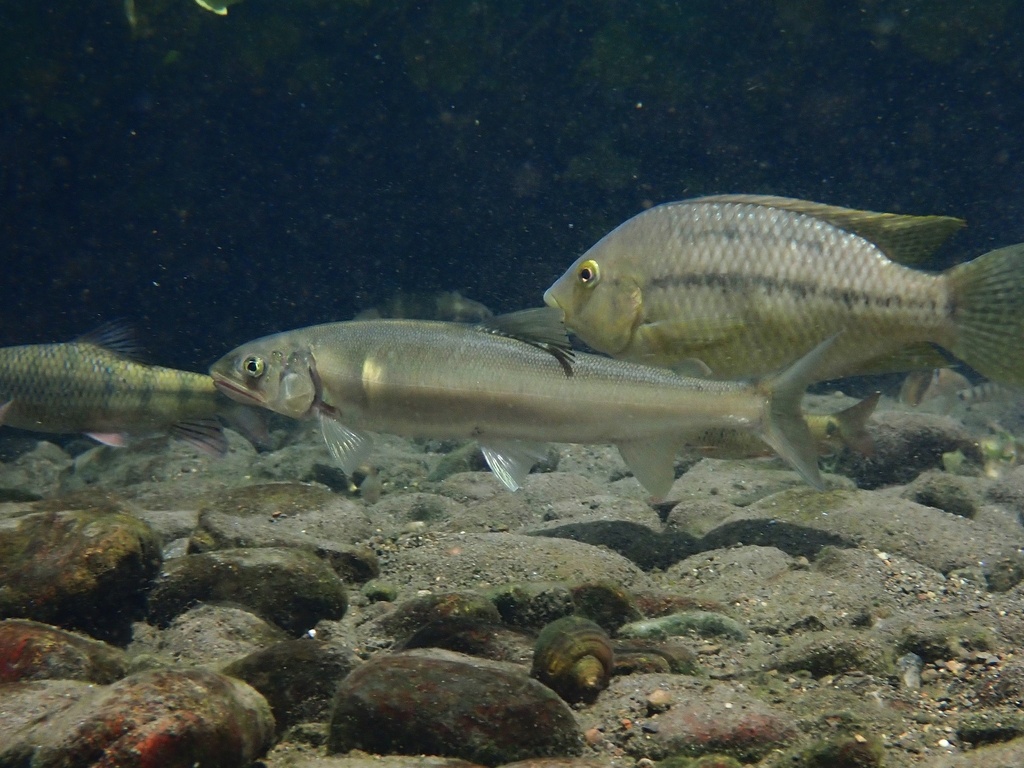
The Ayu (Plecoglossus altivelis) is a fish that lives in both fresh and salt water of the family Plecoglossidae that grows up to 70 cm.
Description
The ayu is a slender, smelt-like migratory fish of the family Plecoglossidae reaching about 70 cm but usually much smaller. The silvery-green body has an adipose fin, as in salmonids, and comb-like teeth with which the fish scrapes diatoms and algae off stones. Adults fiercely defend a grazing territory. The species comes from East Asia and is amphidromous and largely annual: larvae wash to sea, young fish run up the clear river, and after spawning in autumn most die. The flesh smells characteristically of watermelon or cucumber. In Japan the ayu is a highly prized seasonal fish, traditionally caught with the tomozuri method.
Frequently asked questions
How do you recognise the Ayu?
The Ayu has an elongate, eel-like body, is mainly silver-grey and shows a plain pattern.
Where does the Ayu live?
The Ayu lives in both fresh and salt water and is mostly found around stony or rocky ground.
How big does the Ayu get?
The Ayu grows to a maximum of about 70 cm. On average the species is around 15 cm.
Is the Ayu dangerous to humans?
No, the Ayu is harmless to humans.
Is the Ayu edible?
Yes, the Ayu is a highly prized food fish.
Download Fin's Fish Guide
Identify fish in seconds, log your catches and dives. Join the TestFlight beta.
All data
Identification
Appearance
Habitat & distribution
Behaviour & biology
For anglers
Safety
Status & sources
Download Fin's Fish Guide
Identify fish in seconds, log your catches and dives. Join the TestFlight beta.