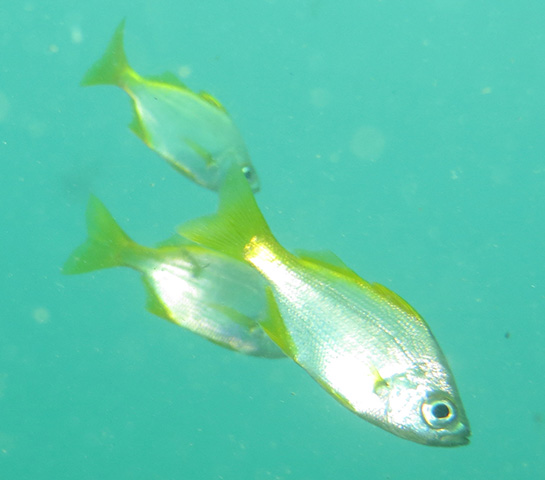
The Largeeye flagtail (Parakuhlia macrophthalmus) is a fish of the family Haemulidae that grows up to 25 cm.
Description
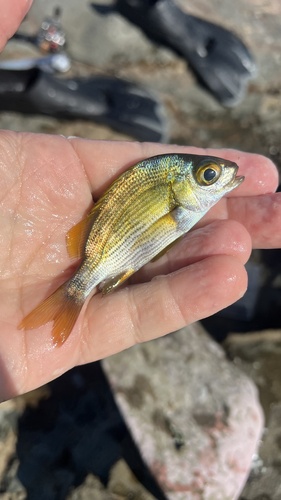
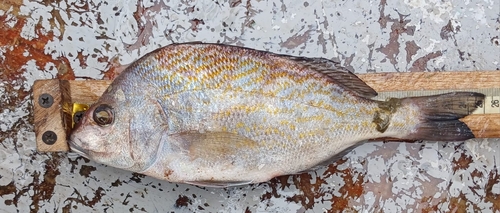
The largeeye flagtail is a perch-like fish (Kuhliidae) from shallow coastal, rocky and estuarine water of the eastern Atlantic around West Africa. The species grows to about 25 cm and has an elongate, silvery body with large eyes and a forked tail. As a social fish it stays near rock and surf and snaps at small crustaceans, small fish and plankton. The fish is harmless to humans.
Frequently asked questions
How do you recognise the Largeeye flagtail?
The Largeeye flagtail is mainly silver-grey.
Where does the Largeeye flagtail live?
The Largeeye flagtail is mostly found around stony or rocky ground.
How big does the Largeeye flagtail get?
The Largeeye flagtail grows to a maximum of about 25 cm.
Is the Largeeye flagtail dangerous to humans?
No, the Largeeye flagtail is harmless to humans.
Download Fin's Fish Guide
Identify fish in seconds, log your catches and dives. Join the TestFlight beta.
All data
Identification
Appearance
Habitat & distribution
Behaviour & biology
For anglers
Safety
Status & sources
More from the family Haemulidae
Download Fin's Fish Guide
Identify fish in seconds, log your catches and dives. Join the TestFlight beta.