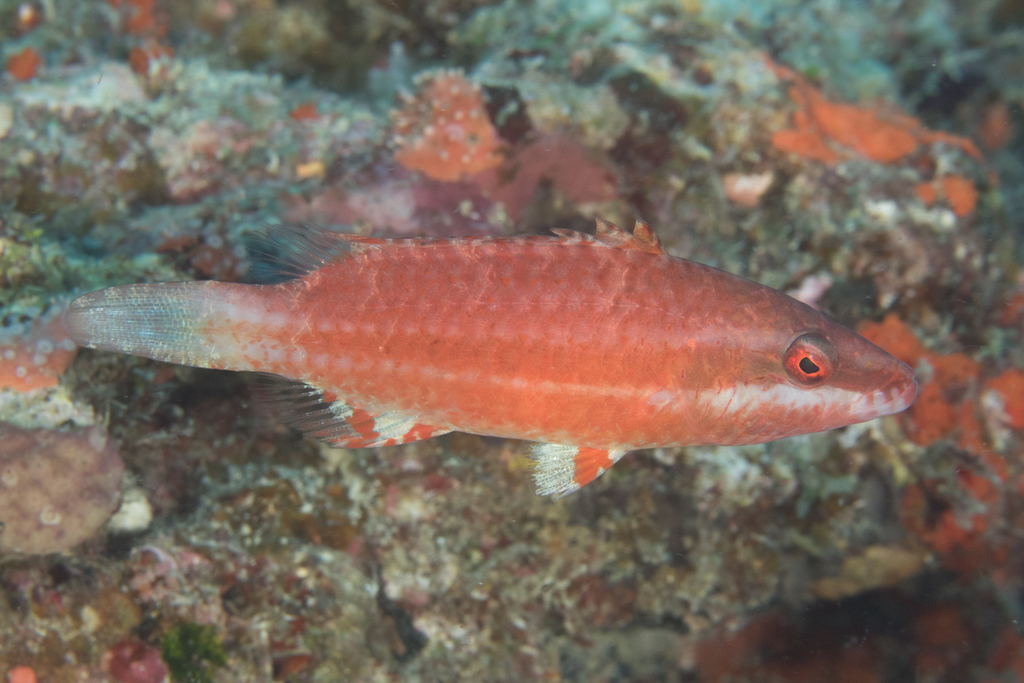
The Bandcheek wrasse (Oxycheilinus digramma) is a brackish-water fish of the family Labridae that grows up to 40 cm.
Description
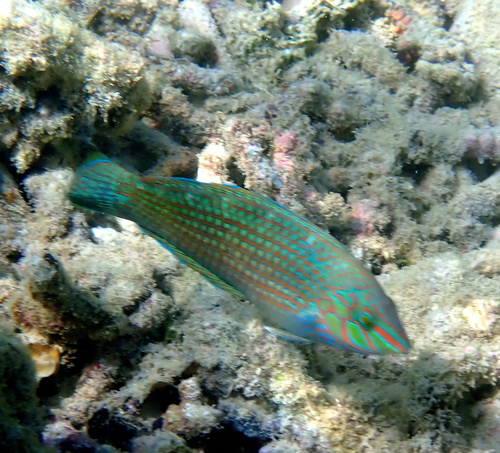
The cheeklined wrasse is a wrasse of the family Labridae from the Indo-West Pacific. The species grows to about 40 cm and has an elongate, greenish to red-brown body with fine streaks and lines on the head, to which the name refers; the colour can change quickly. Adults live solitarily on lagoon and sheltered seaward reefs in coral-rich areas. As a predator it hunts small fishes and crustaceans, sometimes following other foraging fishes. Like many wrasses it changes sex during life, from female to male. The species is harmless to humans.
Frequently asked questions
How do you recognise the Bandcheek wrasse?
The Bandcheek wrasse has a torpedo-shaped body, is mainly green and shows a plain pattern.
Where does the Bandcheek wrasse live?
The Bandcheek wrasse lives in brackish water and is mostly found around stony or rocky ground.
How big does the Bandcheek wrasse get?
The Bandcheek wrasse grows to a maximum of about 40 cm.
Is the Bandcheek wrasse dangerous to humans?
No, the Bandcheek wrasse is harmless to humans.
Is the Bandcheek wrasse edible?
The Bandcheek wrasse is rarely eaten.
Download Fin's Fish Guide
Identify fish in seconds, log your catches and dives. Join the TestFlight beta.
All data
Identification
Appearance
Habitat & distribution
Behaviour & biology
For anglers
Safety
Status & sources
Same genus Oxycheilinus
More from the family Labridae
Download Fin's Fish Guide
Identify fish in seconds, log your catches and dives. Join the TestFlight beta.