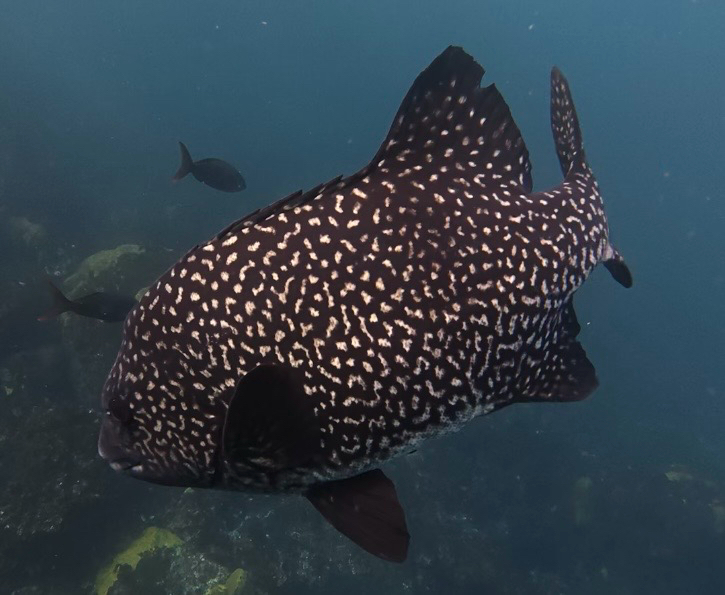
The Pacific beakfish (Oplegnathus insignis) is a saltwater fish of the family Oplegnathidae that grows up to 66 cm.
Description
The Pacific beakfish is a reef fish of the family Oplegnathidae from the eastern Pacific, from the Galapagos to Peru and Chile. The species reaches about 66 cm and has a deep, silvery-grey body with dark bands and spots. Its teeth are fused into a stout, parrot-like beak with which it crushes hard-shelled crustaceans and molluscs; it also eats algae. It is usually solitary and constantly swims over rocky reefs, along steep walls and boulder-strewn slopes, mainly in shallow water. For lack of data the IUCN assesses the species as data deficient (DD).
Frequently asked questions
How do you recognise the Pacific beakfish?
The Pacific beakfish has a flattened, disc-shaped body, is mainly silver-grey and shows a spots pattern.
Where does the Pacific beakfish live?
The Pacific beakfish lives in the sea (marine waters) and is mostly found around stony or rocky ground.
How big does the Pacific beakfish get?
The Pacific beakfish grows to a maximum of about 66 cm. On average the species is around 30 cm.
Is the Pacific beakfish dangerous to humans?
No, the Pacific beakfish is harmless to humans.
Is the Pacific beakfish edible?
The Pacific beakfish is rarely eaten.
Download Fin's Fish Guide
Identify fish in seconds, log your catches and dives. Join the TestFlight beta.
All data
Identification
Appearance
Habitat & distribution
Behaviour & biology
For anglers
Safety
Status & sources
Same genus Oplegnathus
More from the family Oplegnathidae
Download Fin's Fish Guide
Identify fish in seconds, log your catches and dives. Join the TestFlight beta.