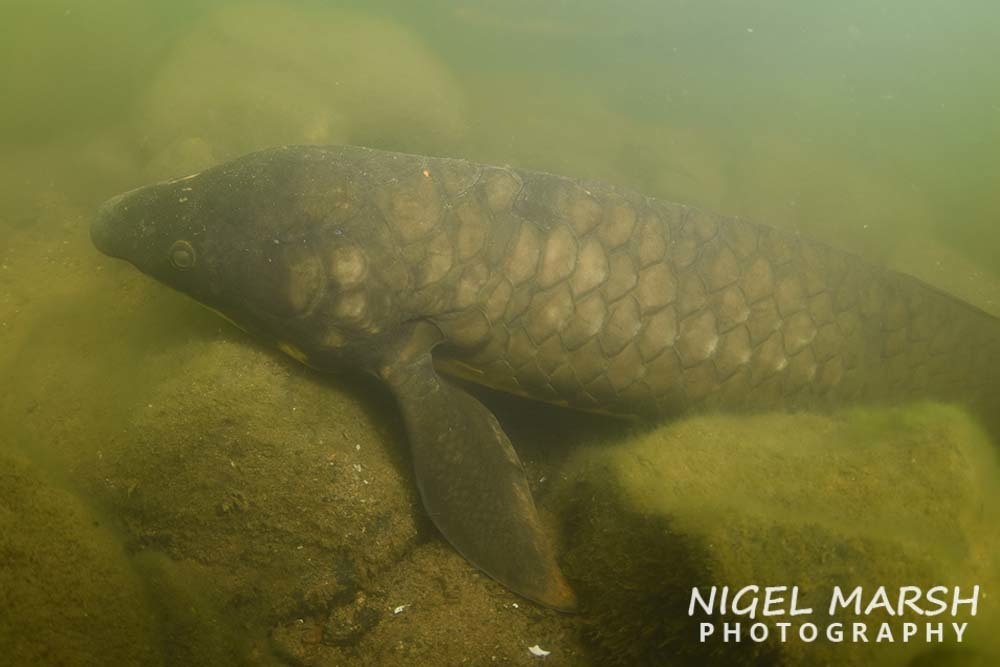
The Australian lungfish (Neoceratodus forsteri) is a freshwater fish of the family Neoceratodontidae that grows up to 170 cm.
Description
The Australian lungfish is an ancient freshwater fish of the family Neoceratodontidae, endemic to a few river systems of Queensland in Australia. The species grows to about 1.7 metres and has a heavy, elongate body with large scales and fleshy, paddle-shaped fins. As a 'living fossil' it has a single lung with which, unlike its African and South American relatives, it only occasionally gulps air in oxygen-poor water; it cannot survive drought by burrowing. It inhabits quiet rivers and pools with mud, sand or gravel bottoms. As a sluggish omnivore it feeds on small invertebrates, molluscs and plant matter. Owing to threats to its habitat it is listed as Endangered (EN) and is legally protected.
Frequently asked questions
How do you recognise the Australian lungfish?
The Australian lungfish has an elongate, eel-like body, is mainly brown and shows a plain pattern.
Where does the Australian lungfish live?
The Australian lungfish lives in fresh water and is mostly found around sand or mud bottom.
How big does the Australian lungfish get?
The Australian lungfish grows to a maximum of about 170 cm. On average the species is around 100 cm.
Is the Australian lungfish dangerous to humans?
No, the Australian lungfish is harmless to humans.
Is the Australian lungfish edible?
The Australian lungfish is not usually eaten.
Download Fin's Fish Guide
Identify fish in seconds, log your catches and dives. Join the TestFlight beta.
All data
Identification
Appearance
Habitat & distribution
Behaviour & biology
For anglers
Safety
Status & sources
Download Fin's Fish Guide
Identify fish in seconds, log your catches and dives. Join the TestFlight beta.