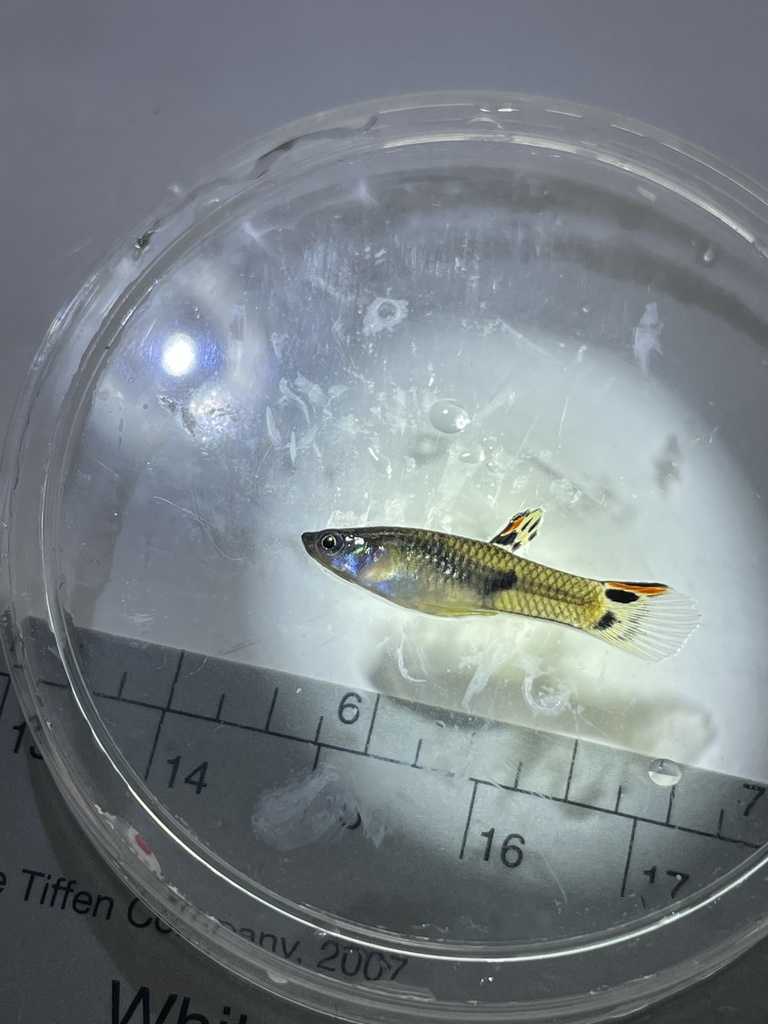
The Painted livebearer (Micropoecilia picta) is a brackish-water fish of the family Poeciliidae that grows up to 4 cm.
Description
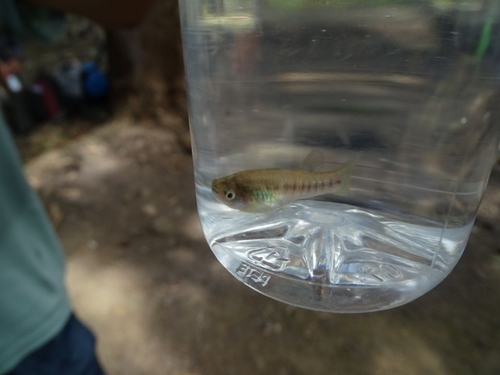
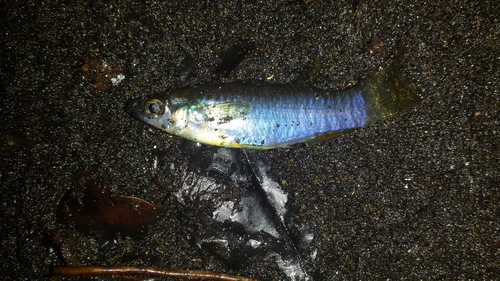
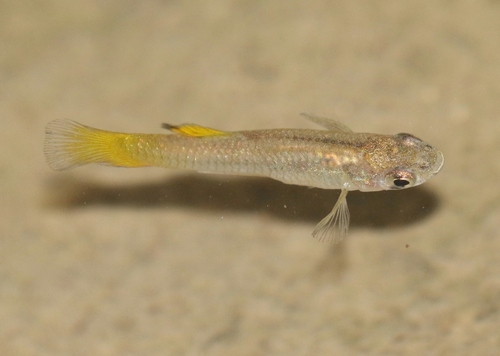
The painted livebearer is a small livebearing fish of the family Poeciliidae from northern South America, along the coastal areas of the Guianas, Venezuela and northern Brazil. The species reaches only about 4 cm; the males are brightly coloured with scarlet to orange accents, the females inconspicuous silvery-grey. It mainly inhabits brackish coastal water, lagoons and river mouths. As an omnivore it feeds on algae, detritus and small zooplankton. Fertilisation is internal and the female bears live young; the species is related to the well-known guppy.
Frequently asked questions
How do you recognise the Painted livebearer?
The Painted livebearer has a torpedo-shaped body, is mainly red-orange and shows a spots pattern.
Where does the Painted livebearer live?
The Painted livebearer lives in brackish water and is mostly found around open water.
How big does the Painted livebearer get?
The Painted livebearer grows to a maximum of about 4 cm. On average the species is around 3 cm.
Is the Painted livebearer dangerous to humans?
No, the Painted livebearer is harmless to humans.
Is the Painted livebearer edible?
The Painted livebearer is not usually eaten.
Download Fin's Fish Guide
Identify fish in seconds, log your catches and dives. Join the TestFlight beta.
All data
Identification
Appearance
Habitat & distribution
Behaviour & biology
For anglers
Safety
Status & sources
More from the family Poeciliidae


Download Fin's Fish Guide
Identify fish in seconds, log your catches and dives. Join the TestFlight beta.