
The Bigmouth buffalo (Ictiobus cyprinellus) is a freshwater fish of the family Catostomidae that grows up to 123 cm.
Description
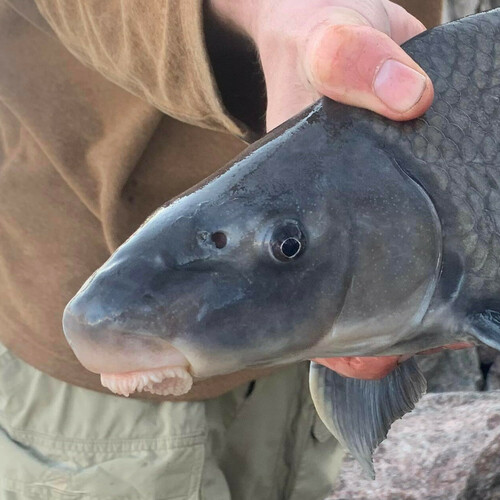
The bigmouth buffalo is a large sucker (Catostomidae) from North America, in the Mississippi basin, the Great Lakes and the Hudson Bay drainage. The species can reach about 123 cm and has a stocky, bronze-brown body and, unlike most suckers, a large, obliquely set terminal mouth. It inhabits main channels, pools and backwaters of rivers, lakes and reservoirs in water less than five metres deep. It filters zooplankton such as water fleas and copepods, supplemented with midge larvae. The species is remarkable: it is among the longest-lived freshwater fishes in the world and can reach well over a hundred years of age.
Frequently asked questions
How do you recognise the Bigmouth buffalo?
The Bigmouth buffalo has a torpedo-shaped body, is mainly brown and shows a plain pattern.
Where does the Bigmouth buffalo live?
The Bigmouth buffalo lives in fresh water and is mostly found around mixed bottom.
How big does the Bigmouth buffalo get?
The Bigmouth buffalo grows to a maximum of about 123 cm. On average the species is around 36 cm.
Is the Bigmouth buffalo dangerous to humans?
No, the Bigmouth buffalo is harmless to humans.
Is the Bigmouth buffalo edible?
The Bigmouth buffalo is rarely eaten.
Download Fin's Fish Guide
Identify fish in seconds, log your catches and dives. Join the TestFlight beta.
All data
Identification
Appearance
Habitat & distribution
Behaviour & biology
For anglers
Safety
Status & sources
Same genus Ictiobus


More from the family Catostomidae





Download Fin's Fish Guide
Identify fish in seconds, log your catches and dives. Join the TestFlight beta.