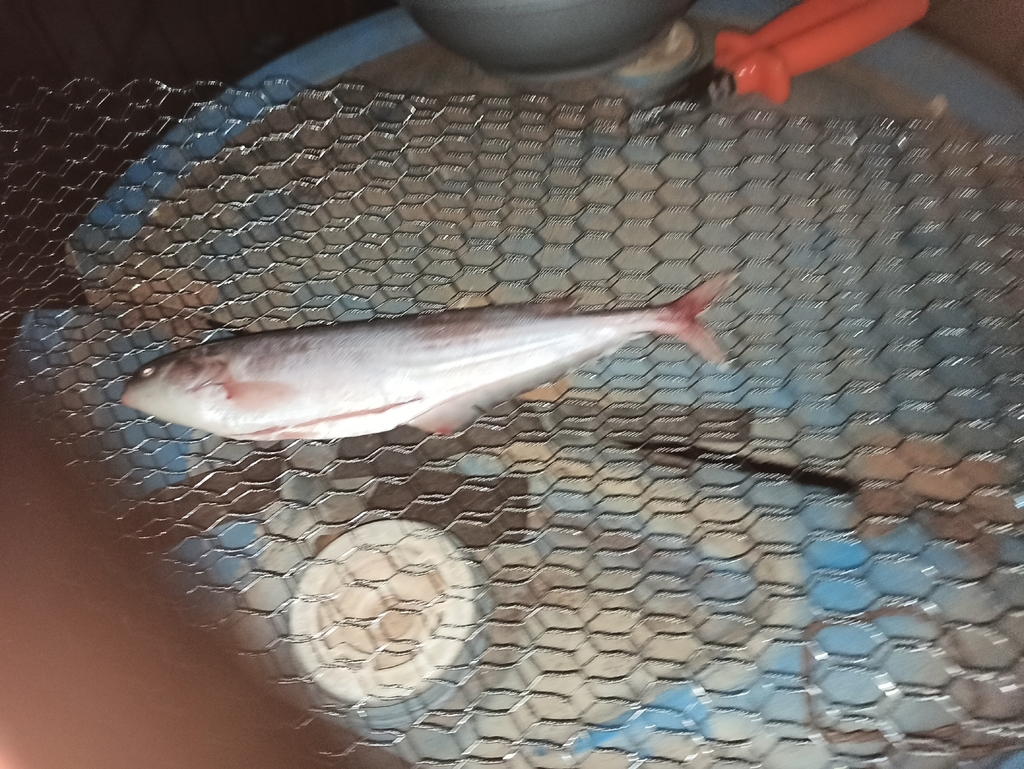
The Ngai (Hyperopisus bebe) is a brackish-water fish of the family Mormyridae that grows up to 51 cm.
Description
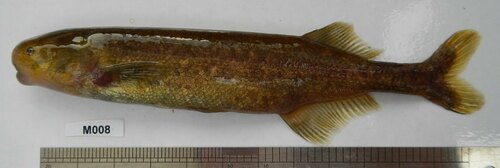
Hyperopisus bebe is an African elephantfish (Mormyridae) from fresh water of the Sahel region and Northeast Africa, including the Nile, the Niger and the Senegal. The species has a streamlined, silvery-grey body with a downward-pointing snout and reaches about 51 cm. It inhabits both still and flowing waters and breeds in the flood season. Like other mormyrids it has electroreceptors over almost the entire body and a weak electric organ with which it orients itself in turbid water. It feeds mainly on mollusks, which it picks from the bottom. Owing to its size the species is important for fisheries.
Frequently asked questions
How do you recognise the Ngai?
The Ngai has a torpedo-shaped body, is mainly silver-grey and shows a plain pattern.
Where does the Ngai live?
The Ngai lives in brackish water and is mostly found around sand or mud bottom.
How big does the Ngai get?
The Ngai grows to a maximum of about 51 cm.
Is the Ngai dangerous to humans?
No, the Ngai is harmless to humans.
Is the Ngai edible?
Yes, the Ngai is commonly eaten.
Download Fin's Fish Guide
Identify fish in seconds, log your catches and dives. Join the TestFlight beta.
All data
Identification
Appearance
Habitat & distribution
Behaviour & biology
For anglers
Safety
Status & sources
More from the family Mormyridae




Download Fin's Fish Guide
Identify fish in seconds, log your catches and dives. Join the TestFlight beta.