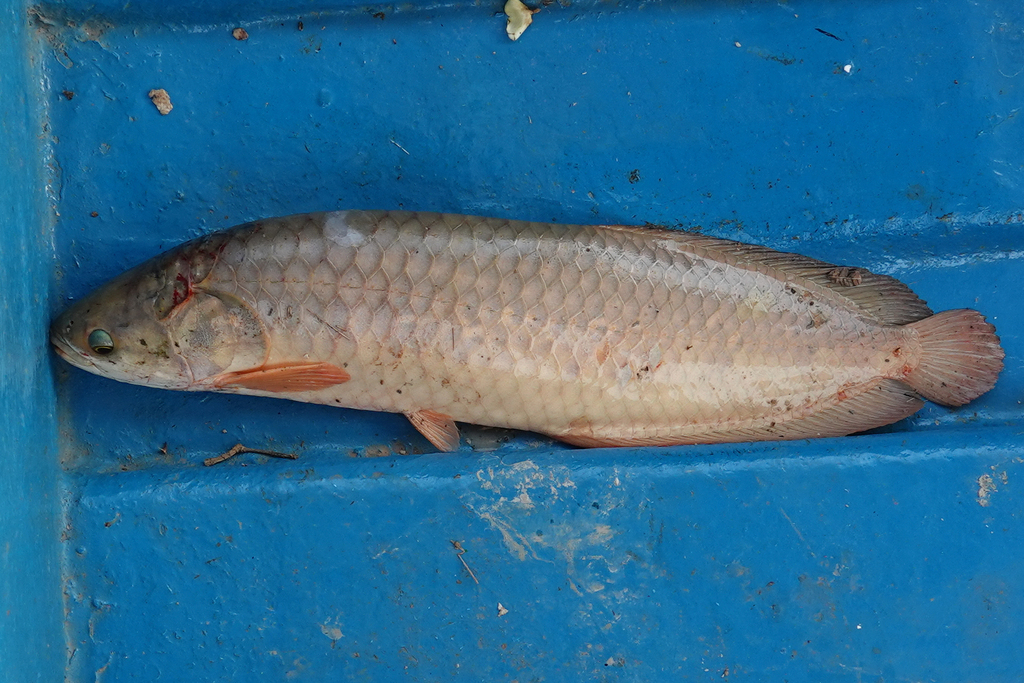
The African arowana (Heterotis niloticus) is a freshwater fish of the family Arapaimidae that grows up to 100 cm.
Description
The African bonytongue (Heterotis niloticus) is a large, ancient freshwater fish of the family Arapaimidae from the Sahel region and West Africa. The species has an elongate, silvery-grey body with large scales and a 'bony tongue', characteristic of the bonytongues, and can reach about one metre. It has an organ that functions as a lung and must breathe air, allowing it to survive oxygen-poor water. Unlike its predatory relatives this is a filter feeder that sifts plankton and detritus from the water with fine gill rakers. It builds a large, circular nest of plant material and guards the young. Owing to its fast growth and hardiness it is an important farmed and food fish.
Frequently asked questions
How do you recognise the African arowana?
The African arowana has a torpedo-shaped body, is mainly silver-grey and shows a plain pattern.
Where does the African arowana live?
The African arowana lives in fresh water and is mostly found around open water.
How big does the African arowana get?
The African arowana grows to a maximum of about 100 cm.
Is the African arowana dangerous to humans?
No, the African arowana is harmless to humans.
Is the African arowana edible?
Yes, the African arowana is commonly eaten.
Download Fin's Fish Guide
Identify fish in seconds, log your catches and dives. Join the TestFlight beta.
All data
Identification
Appearance
Habitat & distribution
Behaviour & biology
For anglers
Safety
Status & sources
More from the family Arapaimidae
Download Fin's Fish Guide
Identify fish in seconds, log your catches and dives. Join the TestFlight beta.