Home · Mitsukurinidae · Goblin shark
Goblin shark (Mitsukurina owstoni) — Mitsukurinidae

Goblin shark

Mitsukurina owstoni
LC · Least Concern

The Goblin shark (Mitsukurina owstoni) is a saltwater fish of the family Mitsukurinidae that grows up to 617 cm.

Length
617 cm
Water
Saltwater
Depth
30.0–1300.0 m
Diet
Carnivore
Behaviour
Solitary
Activity
Nocturnal
Body shape
Elongated (eel-like)
Substrate
Sand / mud bottom
Danger
Harmless
Range
Worldwide deep sea
Edibility
Not eaten

Want the complete picture on the Goblin shark?

Get the app

Description

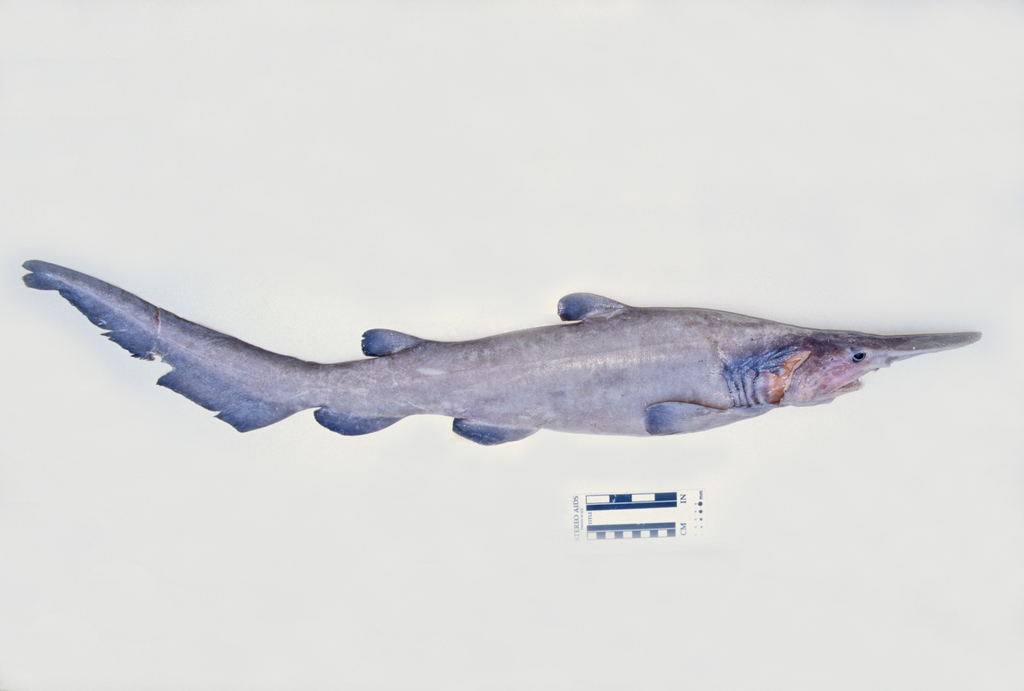
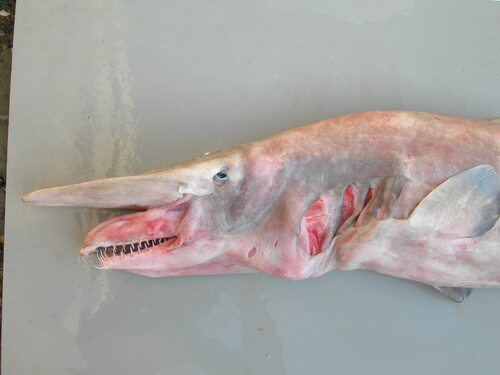
The goblin shark is a striking deep-sea shark occurring worldwide in all oceans. The species can grow to over 6 metres and has a soft, flabby body with a long, flat, blade-like snout and highly protrusible jaws full of needle-sharp teeth, with which it sucks in prey at lightning speed. The skin is pinkish-white due to blood vessels showing through. It lives at great depth along continental slopes, usually between 270 and 960 metres, and hunts fish, squid and crustaceans. It is a living fossil, the only surviving species of its family. Because of its deep habitat it is harmless to humans; the IUCN assesses it as Least Concern (LC).

Frequently asked questions

How do you recognise the Goblin shark?

The Goblin shark has an elongate, eel-like body, is mainly pink-purple and shows a plain pattern. Long flat sword-shaped snout and protrusible jaws; living fossil

Where does the Goblin shark live?

The Goblin shark lives in the sea (marine waters) and is mostly found around sand or mud bottom. Worldwide deep sea

How big does the Goblin shark get?

The Goblin shark grows to a maximum of about 617 cm. On average the species is around 200 cm.

Is the Goblin shark dangerous to humans?

No, the Goblin shark is harmless to humans. This species is harmless to humans. No specific first aid is needed. Still handle the fish with care: mind the fin rays and the sharp edges of the gill cover, and rinse any scratch with clean water and cover it. For a dirty or deep wound check tetanus status.

Is the Goblin shark edible?

The Goblin shark is not usually eaten.

More photos
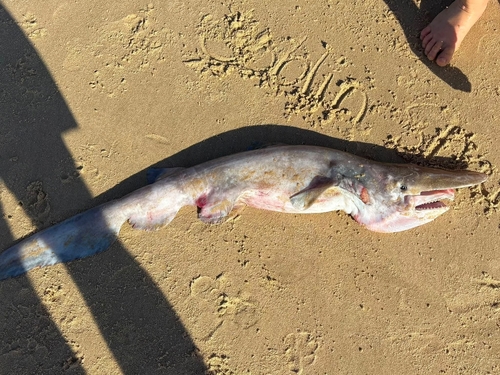
Goblin shark (Mitsukurina owstoni) — Mitsukurinidae — 2
iNaturalist ((c) Karen Scaife, some rights reserved (CC BY-NC))
Goblin shark (Mitsukurina owstoni) — Mitsukurinidae — 3
Wikimedia Commons — see below (Public domain)
Goblin shark (Mitsukurina owstoni) — Mitsukurinidae — 4
Wikimedia Commons — Dianne Bray / Museum Victoria (CC BY 3.0 au)
Goblin shark (Mitsukurina owstoni) — Mitsukurinidae — 5
iNaturalist ((c) Gonzalo Mucientes Sandoval, some rights reserved (CC BY-NC))
Fin

Want the complete picture on the Goblin shark?

Point your camera at the fish and Fin names the species in seconds. Free, and the Goblin shark is one of 12,519 species in the app.

Get the app →

All data

Identification

English name
Goblin shark verified
Scientific name
Mitsukurina owstoni
Family
Mitsukurinidae
Other names
Elphin shark; Goblin shark; Elfin shark verified

Appearance

Size class
Extra large verified
Max length (cm)
617.0 verified
Average length (cm)
200.0 verified
Body shape
Elongated (eel-like) sourced
Dominant colour
Pink / purple sourced
Pattern
Plain sourced
Tail shape
Straight inferred
Mouth position
Terminal sourced
Lips
Thin sourced
Barbels
No sourced
Dorsal fins
Two separate sourced
Dorsal spines
No sourced

Habitat & distribution

Water type
Saltwater sourced
Substrate
Sand / mud bottom sourced
Min depth (m)
30.0 verified
Max depth (m)
1300.0 verified
Natural range
Worldwide deep sea verified
Origin
Native verified

Behaviour & biology

Diet
Carnivore sourced
Diet (detail)
Fishes, squid and crustaceans inferred
Social behaviour
Solitary inferred
Territorial
No sourced
Activity
Nocturnal inferred
Reproduction
Separate sexes sourced
Sexual dimorphism
No sourced
Seasonality
Deep-sea shark; present year-round. sourced
Special features
Long flat sword-shaped snout and protrusible jaws; living fossil sourced

For anglers

Edibility
Not eaten sourced
Fishing method
Bottom fishing with natural bait (worm, shrimp or fish) on or just above the seabed. inferred
Regulations source
FishBase ↗ inferred

Safety

Danger to humans
Harmless sourced
First aid
This species is harmless to humans. No specific first aid is needed. Still handle the fish with care: mind the fin rays and the sharp edges of the gill cover, and rinse any scratch with clean water and cover it. For a dirty or deep wound check tetanus status. verified

Status & sources

Sources
FishBase via GBIF (DwC-A), CC-BY-NC 4.0
Fin

Want the complete picture on the Goblin shark?

Point your camera at the fish and Fin names the species in seconds. Free, and the Goblin shark is one of 12,519 species in the app.

Get the app →
Is this the Goblin shark? Get the app