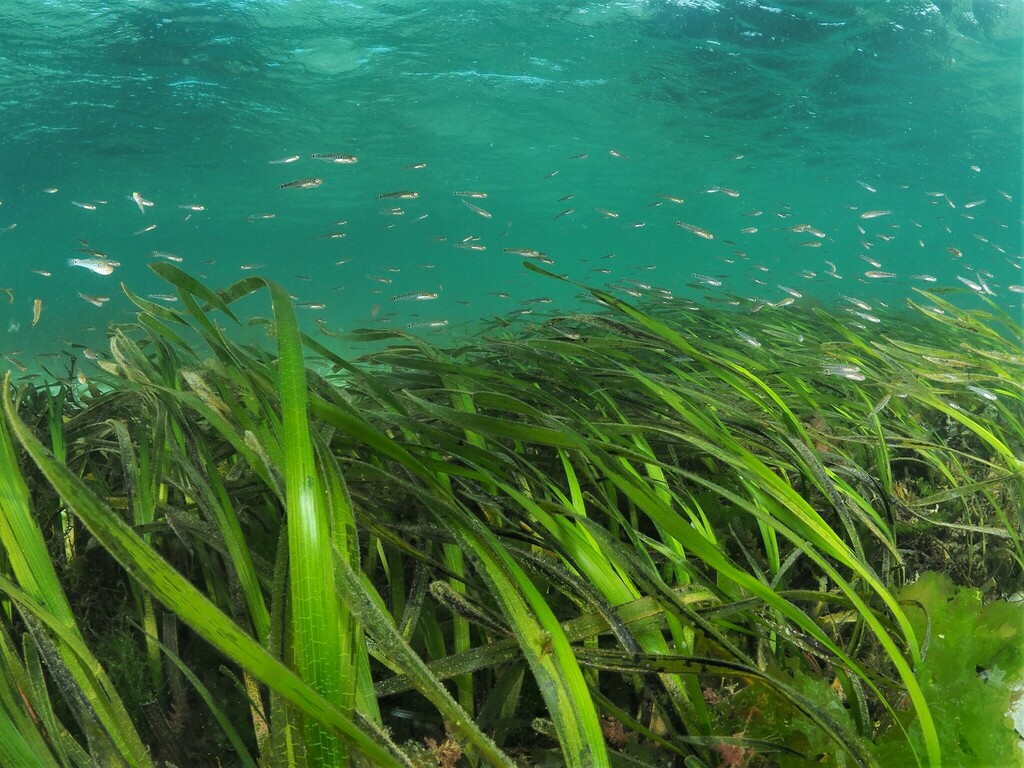
The Two-spotted goby (Gobiusculus flavescens) is a saltwater fish of the family Gobiidae that grows up to 6 cm.
Description
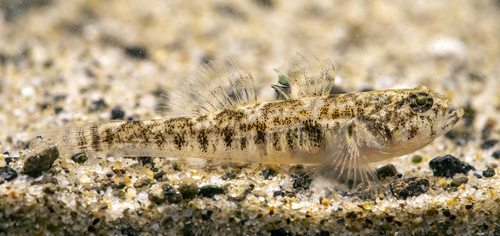
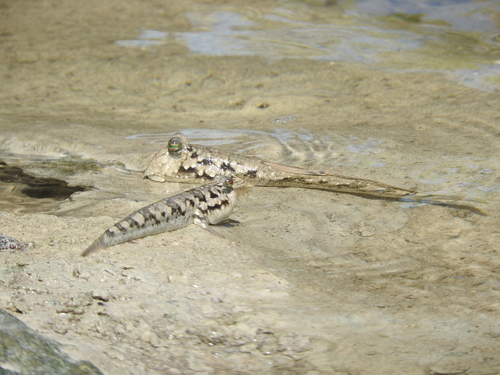
The two-spotted goby is a small, slender goby of the family Gobiidae reaching about 6 cm. Unlike most gobies, which live on the bottom, this species swims freely in loose schools just above weed and seagrass beds. The red-brown, sometimes yellowish body is translucent and bears small spots; males have a conspicuous spot just behind the pectoral fin and, when breeding, a spot at the tail base. The species lives in shallow coastal water of the north-eastern Atlantic and the North Sea, around rocky shores and in seagrass beds. Hovering in the water it picks small zooplankton. In summer the male guards the eggs laid on weed. Because of its small size it has no fishery importance, but it is an important prey.
Frequently asked questions
How do you recognise the Two-spotted goby?
The Two-spotted goby has a torpedo-shaped body, is mainly brown and shows a spots pattern.
Where does the Two-spotted goby live?
The Two-spotted goby lives in the sea (marine waters) and is mostly found around algae or seagrass beds.
How big does the Two-spotted goby get?
The Two-spotted goby grows to a maximum of about 6 cm.
Is the Two-spotted goby dangerous to humans?
No, the Two-spotted goby is harmless to humans.
Is the Two-spotted goby edible?
The Two-spotted goby is not usually eaten.
Download Fin's Fish Guide
Identify fish in seconds, log your catches and dives. Join the TestFlight beta.
All data
Identification
Appearance
Habitat & distribution
Behaviour & biology
For anglers
Safety
Status & sources
More from the family Gobiidae
Download Fin's Fish Guide
Identify fish in seconds, log your catches and dives. Join the TestFlight beta.