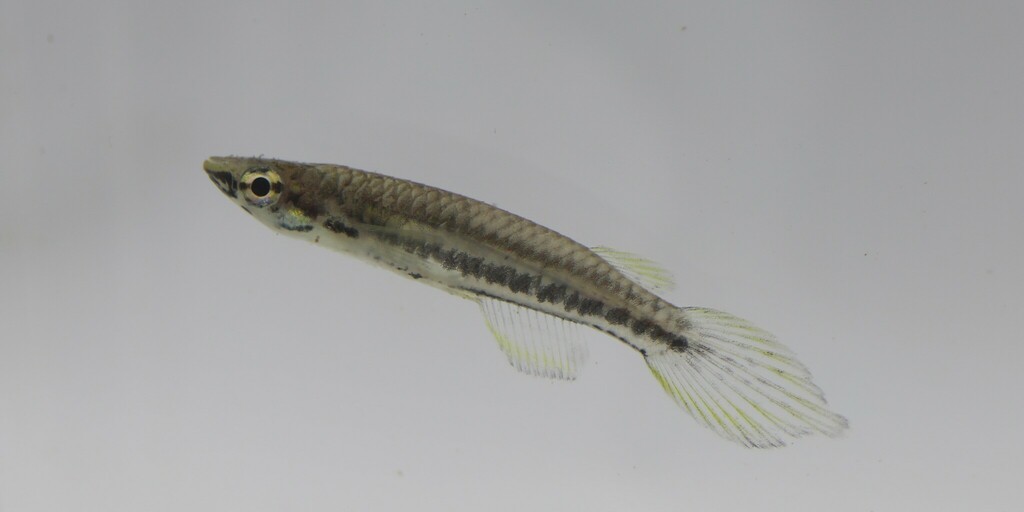
The Banded panchax (Epiplatys bifasciatus) is a freshwater fish of the family Nothobranchiidae that grows up to 6 cm.
Description
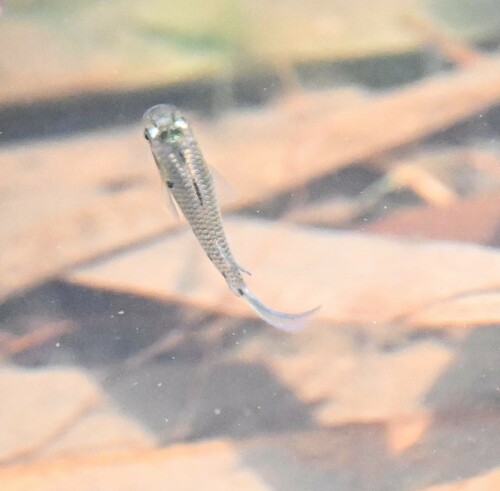
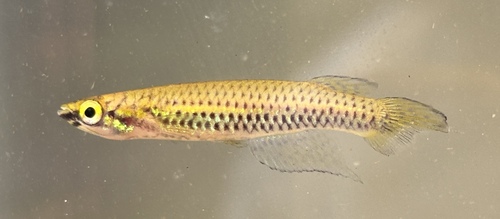
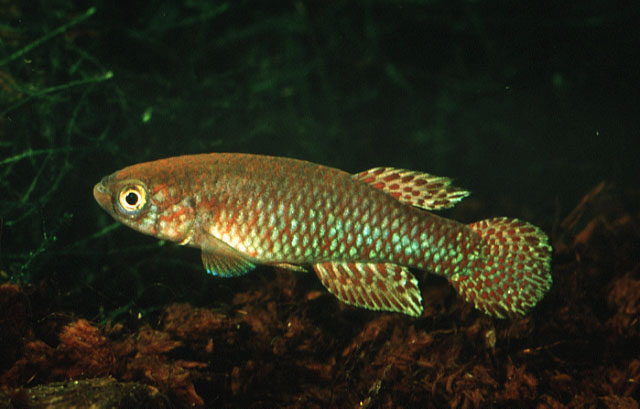
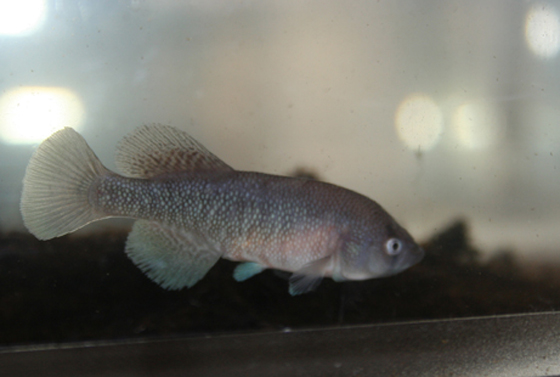
Epiplatys bifasciatus is a small killifish of the family Nothobranchiidae from West Africa. The species has an elongate body with a flattened back and an upward-pointing mouth, adapted to foraging just below the water surface, and usually two dark lengthwise bands; it reaches about 5 cm. It inhabits swamps, small brooks and vegetated parts of rivers in the savanna and coastal areas. As a surface fish it browses algae and higher plants and eats insects and small invertebrates. Owing to its hardiness and colour the species is prized by killifish enthusiasts; it is also eaten locally.
Frequently asked questions
How do you recognise the Banded panchax?
The Banded panchax has an elongate, eel-like body, is mainly yellow-gold and shows a horizontal stripes pattern.
Where does the Banded panchax live?
The Banded panchax lives in fresh water and is mostly found around mixed bottom.
How big does the Banded panchax get?
The Banded panchax grows to a maximum of about 6 cm.
Is the Banded panchax dangerous to humans?
No, the Banded panchax is harmless to humans.
Is the Banded panchax edible?
The Banded panchax is not usually eaten.
Download Fin's Fish Guide
Identify fish in seconds, log your catches and dives. Join the TestFlight beta.
All data
Identification
Appearance
Habitat & distribution
Behaviour & biology
For anglers
Safety
Status & sources
Same genus Epiplatys
More from the family Nothobranchiidae


Download Fin's Fish Guide
Identify fish in seconds, log your catches and dives. Join the TestFlight beta.