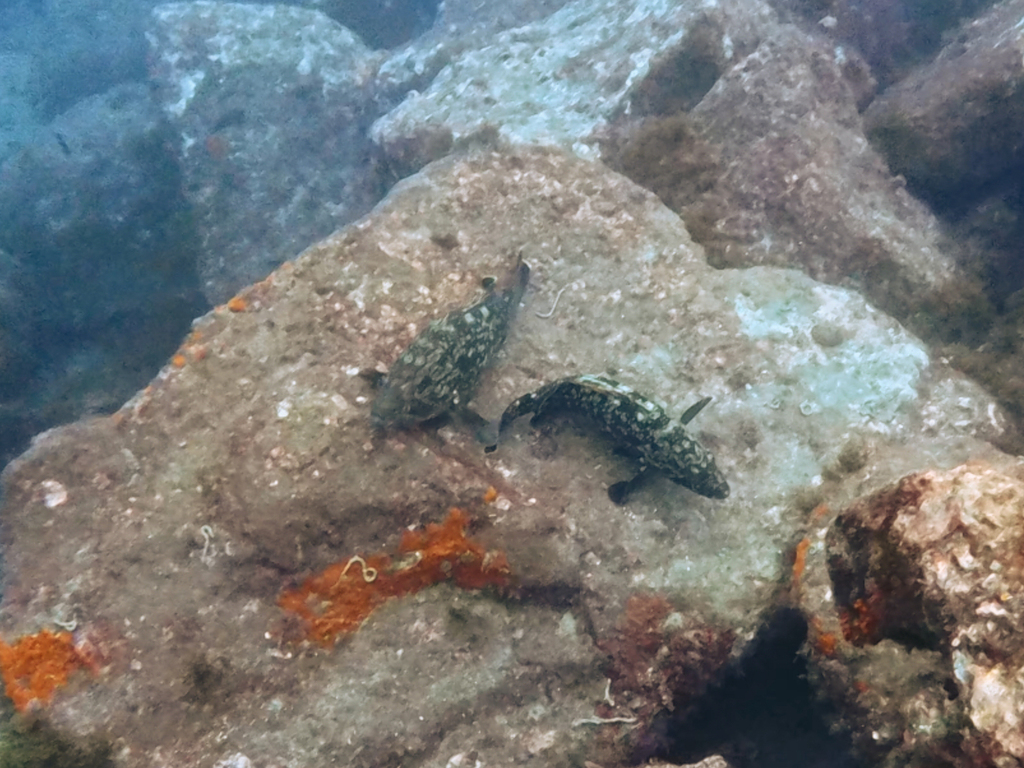
The Dusky grouper (Epinephelus marginatus) is a saltwater fish of the family Serranidae that grows up to 150 cm.
Description
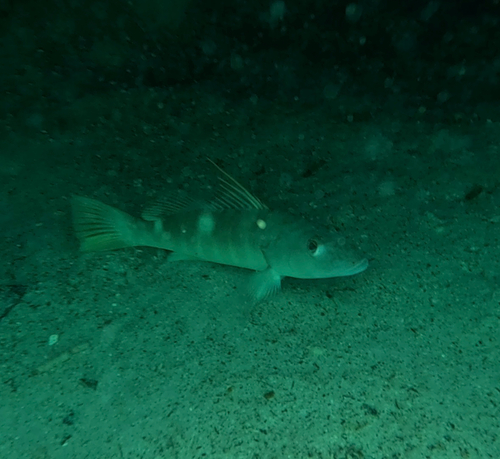
The dusky grouper is a robust grouper of the family Serranidae reaching about 1.5 metres. The sturdy, dark-brown body bears irregular pale blotches and has a rounded tail and thick lips. Like many groupers it is a protogynous hermaphrodite: individuals begin as females and later, as large animals, become males. The species lives sedentarily near rocky bottoms, cliffs and reefs in the eastern Atlantic and the Mediterranean, often at a fixed shelter. As an ambush predator it takes octopus, crabs, lobsters and fish. Because of its curious, site-attached nature it is vulnerable to spearfishing; through overfishing it is assessed as Vulnerable (VU).
Frequently asked questions
How do you recognise the Dusky grouper?
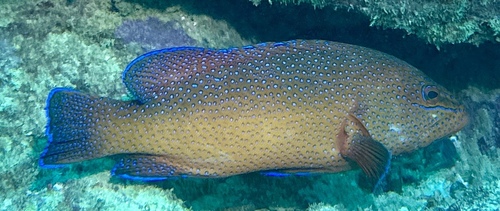
The Dusky grouper has a torpedo-shaped body, is mainly brown and shows a spots pattern.
Where does the Dusky grouper live?
The Dusky grouper lives in the sea (marine waters) and is mostly found around stony or rocky ground.
How big does the Dusky grouper get?
The Dusky grouper grows to a maximum of about 150 cm.
Is the Dusky grouper dangerous to humans?
No, the Dusky grouper is harmless to humans.
Is the Dusky grouper edible?
Yes, the Dusky grouper is a highly prized food fish.
Download Fin's Fish Guide
Identify fish in seconds, log your catches and dives. Join the TestFlight beta.
All data
Identification
Appearance
Habitat & distribution
Behaviour & biology
For anglers
Safety
Status & sources
Same genus Epinephelus
More from the family Serranidae



Download Fin's Fish Guide
Identify fish in seconds, log your catches and dives. Join the TestFlight beta.