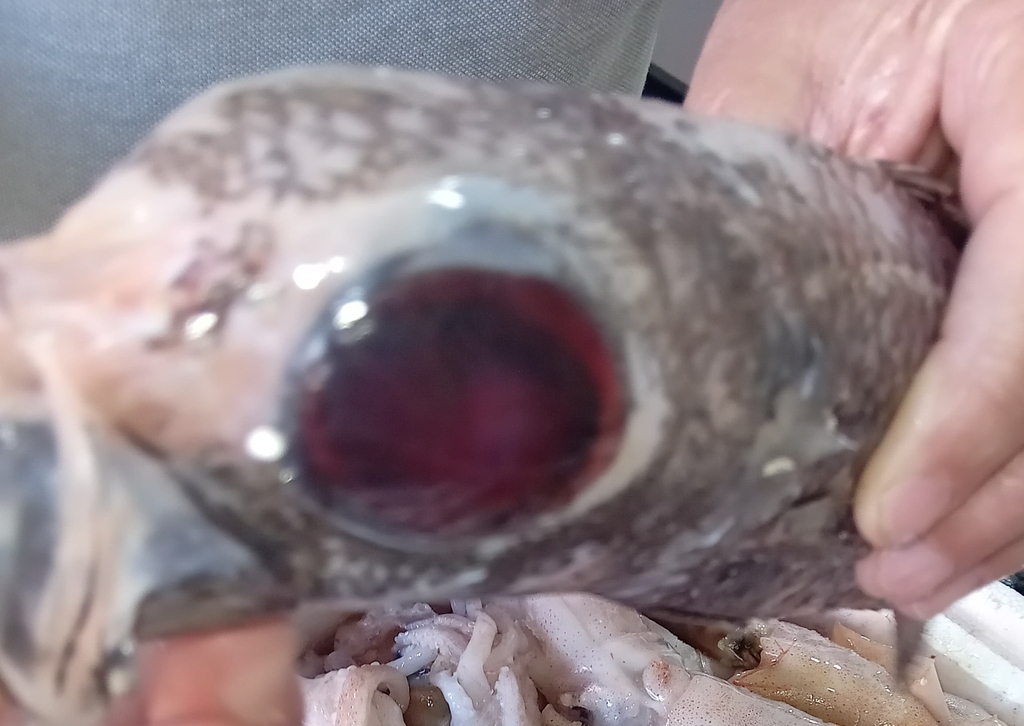
The Bigeye (Epigonus telescopus) is a saltwater fish of the family Epigonidae that grows up to 75 cm.
Description
The black cardinal fish is a deep-sea fish of the family Epigonidae reaching about 75 cm. It has notably large eyes and an iridescent brown-violet to black body, adapted to the dim light of the deep sea. There are two dorsal fins, the first with spines, and a forked tail. The black cardinal fish lives bathydemersally in the northern and southern Atlantic, the Indian Ocean and the south-western Pacific, usually between 300 and 800 m, hunting small fishes and planktonic invertebrates. It grows extremely slowly and can live well over a hundred years, which makes it highly vulnerable to fishing pressure.
Frequently asked questions
How do you recognise the Bigeye?
The Bigeye has a torpedo-shaped body, is mainly black and shows a plain pattern.
Where does the Bigeye live?
The Bigeye lives in the sea (marine waters) and is mostly found around sand or mud bottom.
How big does the Bigeye get?
The Bigeye grows to a maximum of about 75 cm. On average the species is around 55 cm.
Is the Bigeye dangerous to humans?
No, the Bigeye is harmless to humans.
Is the Bigeye edible?
The Bigeye is rarely eaten.
Download Fin's Fish Guide
Identify fish in seconds, log your catches and dives. Join the TestFlight beta.
All data
Identification
Appearance
Habitat & distribution
Behaviour & biology
For anglers
Safety
Status & sources
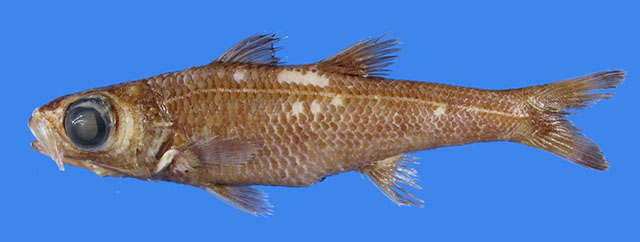
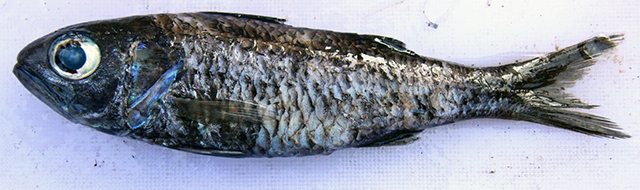
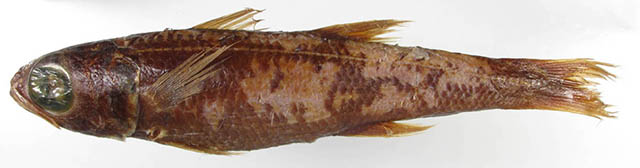
Same genus Epigonus


More from the family Epigonidae

Download Fin's Fish Guide
Identify fish in seconds, log your catches and dives. Join the TestFlight beta.