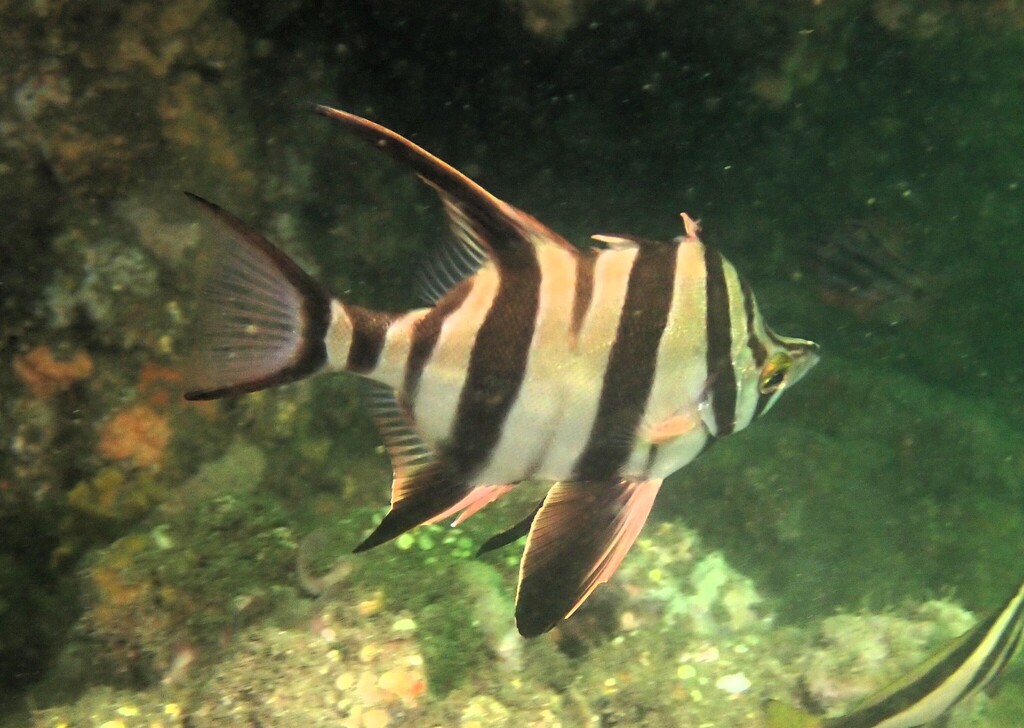
The Angelfish (Enoplosus armatus) is a brackish-water fish of the family Enoplosidae that grows up to 50 cm.
Description
The old wife is the only species of the family Enoplosidae and occurs in the temperate waters around southern Australia. The species grows to about 50 cm and has a deep, strongly laterally compressed, silver-white body with conspicuous black vertical bands and two tall dorsal fins. Juveniles live in estuaries, adults on coastal reefs and around piers, often in pairs or small schools. As an omnivore it feeds on small crustaceans, worms and other bottom animals. The name comes from the grinding sound the fish makes with its teeth when taken out of the water. The dorsal and anal spines are venomous and give a painful puncture wound; therefore handle the fish with care.
Frequently asked questions
How do you recognise the Angelfish?
The Angelfish has an elongate, eel-like body, is mainly white and shows a vertical stripes pattern.
Where does the Angelfish live?
The Angelfish lives in brackish water and is mostly found around stony or rocky ground.
How big does the Angelfish get?
The Angelfish grows to a maximum of about 50 cm.
Is the Angelfish dangerous to humans?
The Angelfish is venomous — handle spines with care and seek medical help after a sting if needed.
Is the Angelfish edible?
The Angelfish is rarely eaten.
Download Fin's Fish Guide
Identify fish in seconds, log your catches and dives. Join the TestFlight beta.
All data
Identification
Appearance
Habitat & distribution
Behaviour & biology
For anglers
Safety
Status & sources
Download Fin's Fish Guide
Identify fish in seconds, log your catches and dives. Join the TestFlight beta.