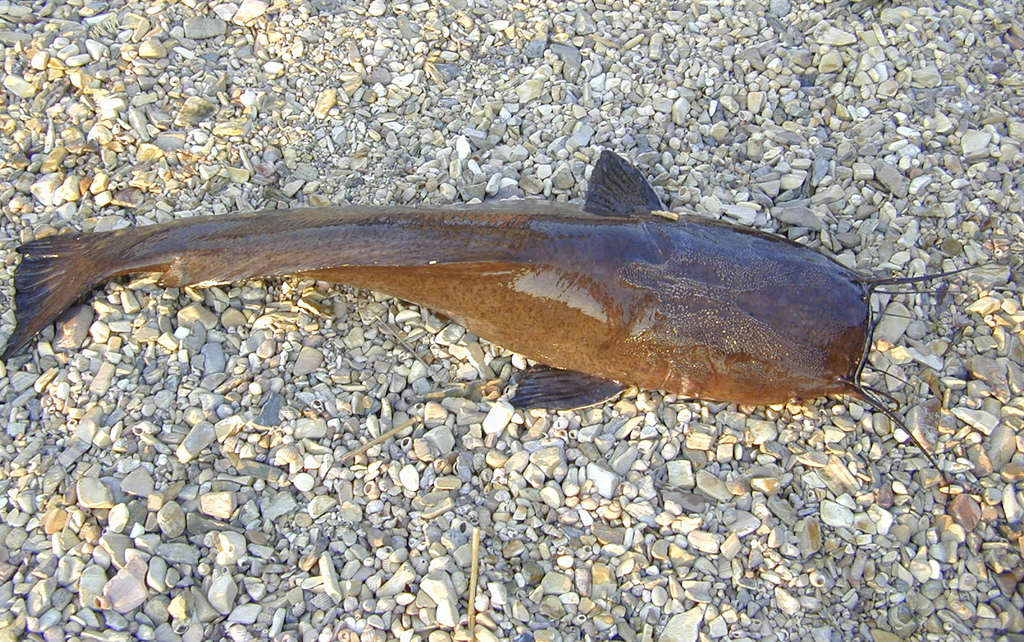
The Tanganyika deepwater catfish (Dinotopterus cunningtoni) is a freshwater fish of the family Clariidae that grows up to 175 cm.
Description
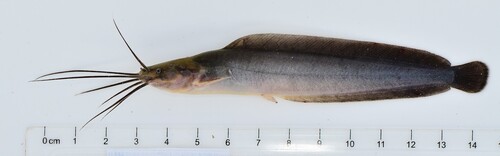
The Tanganyika deepwater catfish is a large air-breathing catfish of the family Clariidae, endemic to Lake Tanganyika in East Africa. The species can reach about 175 cm and has an elongate body with barbels around the mouth and long, continuous fins. It is most common in rocky areas and has a wide depth range, from about 10 to at least 130 metres. As a bottom predator it hunts in the littoral zone. Like other catfishes the pectoral spines can cause painful injuries. The species is listed as Near Threatened (NT) and is of local fishery importance.
Frequently asked questions
How do you recognise the Tanganyika deepwater catfish?
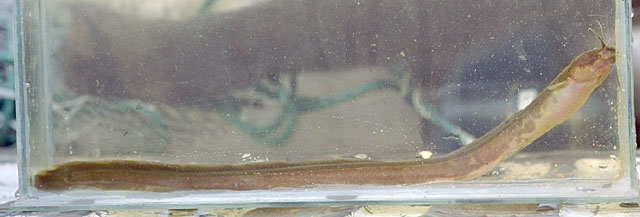
The Tanganyika deepwater catfish has an elongate, eel-like body, is mainly brown and shows a plain pattern.
Where does the Tanganyika deepwater catfish live?
The Tanganyika deepwater catfish lives in fresh water and is mostly found around sand or mud bottom.
How big does the Tanganyika deepwater catfish get?
The Tanganyika deepwater catfish grows to a maximum of about 175 cm.
Is the Tanganyika deepwater catfish dangerous to humans?
No, the Tanganyika deepwater catfish is harmless to humans.
Is the Tanganyika deepwater catfish edible?
Yes, the Tanganyika deepwater catfish is commonly eaten.
Download Fin's Fish Guide
Identify fish in seconds, log your catches and dives. Join the TestFlight beta.
All data
Identification
Appearance
Habitat & distribution
Behaviour & biology
For anglers
Safety
Status & sources
More from the family Clariidae



Download Fin's Fish Guide
Identify fish in seconds, log your catches and dives. Join the TestFlight beta.