Home · Dinolestidae · Jack pike
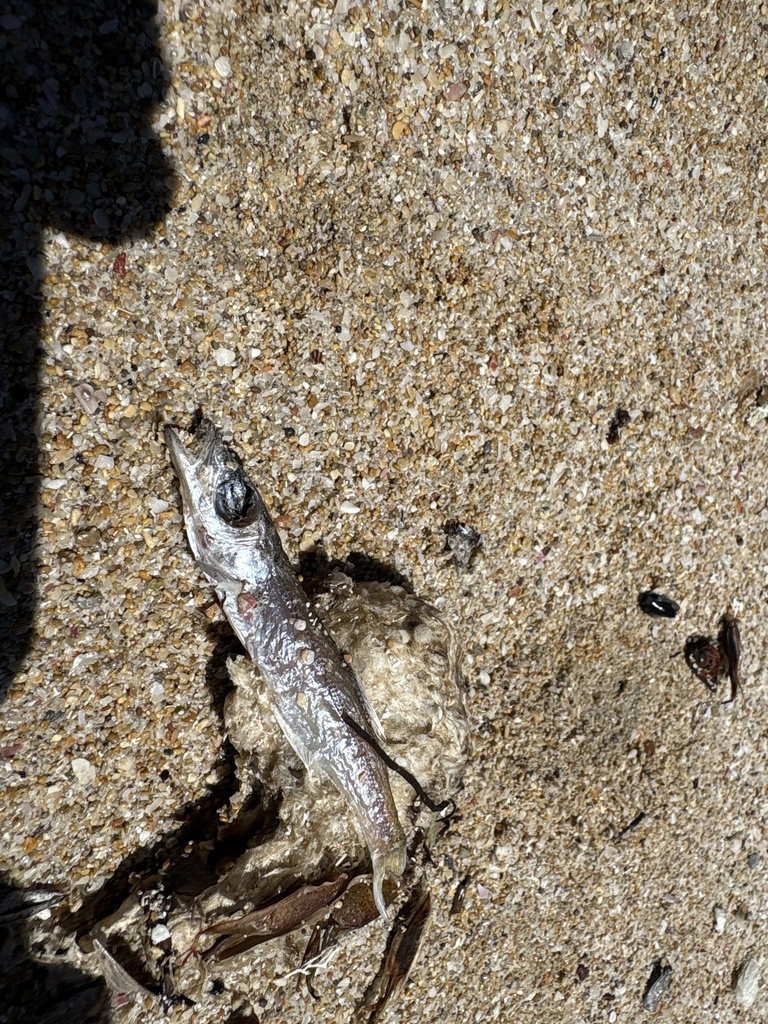
Jack pike (Dinolestes lewini) — Dinolestidae

Jack pike

Dinolestes lewini
Family: Dinolestidae

The Jack pike (Dinolestes lewini) is a saltwater fish of the family Dinolestidae that grows up to 84 cm.

Length
84 cm
Water
Saltwater
Depth
5.0–65.0 m
Diet
Carnivore
Behaviour
Schooling
Activity
Nocturnal
Body shape
Elongated (eel-like)
Substrate
Open water
Danger
Harmless
Edibility
Commonly eaten

Description

The longfin pike is the only species of the family Dinolestidae and occurs in the temperate waters around southern Australia. The species grows to about 84 cm and has an elongate, silvery, pike-like body with a large mouth with fine teeth and large eyes. It forms schools in bays over rocky reefs and in seagrass beds. As a fast, nocturnal predator it hunts small schooling fishes and crustaceans. The longfin pike is a local angling and food fish. Despite its pike-like appearance and teeth it is harmless to humans.

Frequently asked questions

How do you recognise the Jack pike?

The Jack pike has an elongate, eel-like body, is mainly silver-grey and shows a plain pattern.

Where does the Jack pike live?

The Jack pike lives in the sea (marine waters) and is mostly found around open water.

How big does the Jack pike get?

The Jack pike grows to a maximum of about 84 cm.

Is the Jack pike dangerous to humans?

No, the Jack pike is harmless to humans.

Is the Jack pike edible?

Yes, the Jack pike is commonly eaten.

Download Fin's Fish Guide

Identify fish in seconds, log your catches and dives. Join the TestFlight beta.

Get the beta →

All data

Identification

Dutch name
Langvin-zeesnoek sourced
English name
Jack pike verified
Scientific name
Dinolestes lewini
Family
Dinolestidae
Other names
Longfin pike; Long-finned pike; Long-finned seapike; Pike; Skipjack pike verified

Appearance

Size class
Extra large verified
Max length (cm)
84.0 verified
Body shape
Elongated (eel-like) sourced
Dominant colour
Silver / grey inferred
Pattern
Plain inferred
Tail shape
Forked inferred
Mouth position
Terminal inferred
Lips
Thin inferred
Barbels
No sourced
Dorsal fins
Two separate inferred
Dorsal spines
Yes sourced

Habitat & distribution

Water type
Saltwater sourced
Substrate
Open water sourced
Min depth (m)
5.0 verified
Max depth (m)
65.0 verified
Origin
Native sourced

Behaviour & biology

Diet
Carnivore sourced
Social behaviour
Schooling inferred
Territorial
No inferred
Activity
Nocturnal inferred
Reproduction
Separate sexes sourced
Sexual dimorphism
No inferred

For anglers

Edibility
Commonly eaten sourced
Fishing method
Sportvissen met kunstaas of (dood/levend) aasvis door te trollen, te werpen of drijvend te vissen in open water. inferred
Regulations source
FishBase ↗ inferred

Safety

Danger to humans
Harmless sourced

Status & sources

Sources
FishBase via GBIF (DwC-A), CC-BY-NC 4.0

Download Fin's Fish Guide

Identify fish in seconds, log your catches and dives. Join the TestFlight beta.

Get the beta →