 Fin's Fish Guide

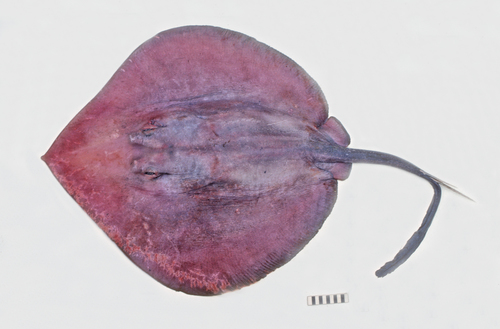
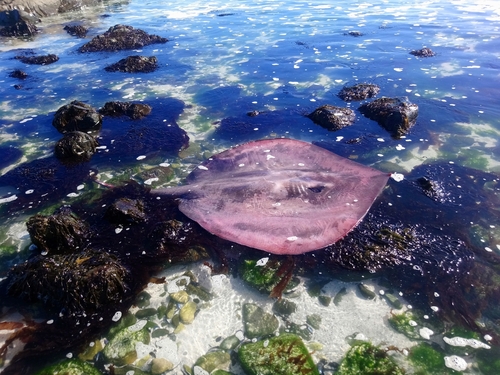
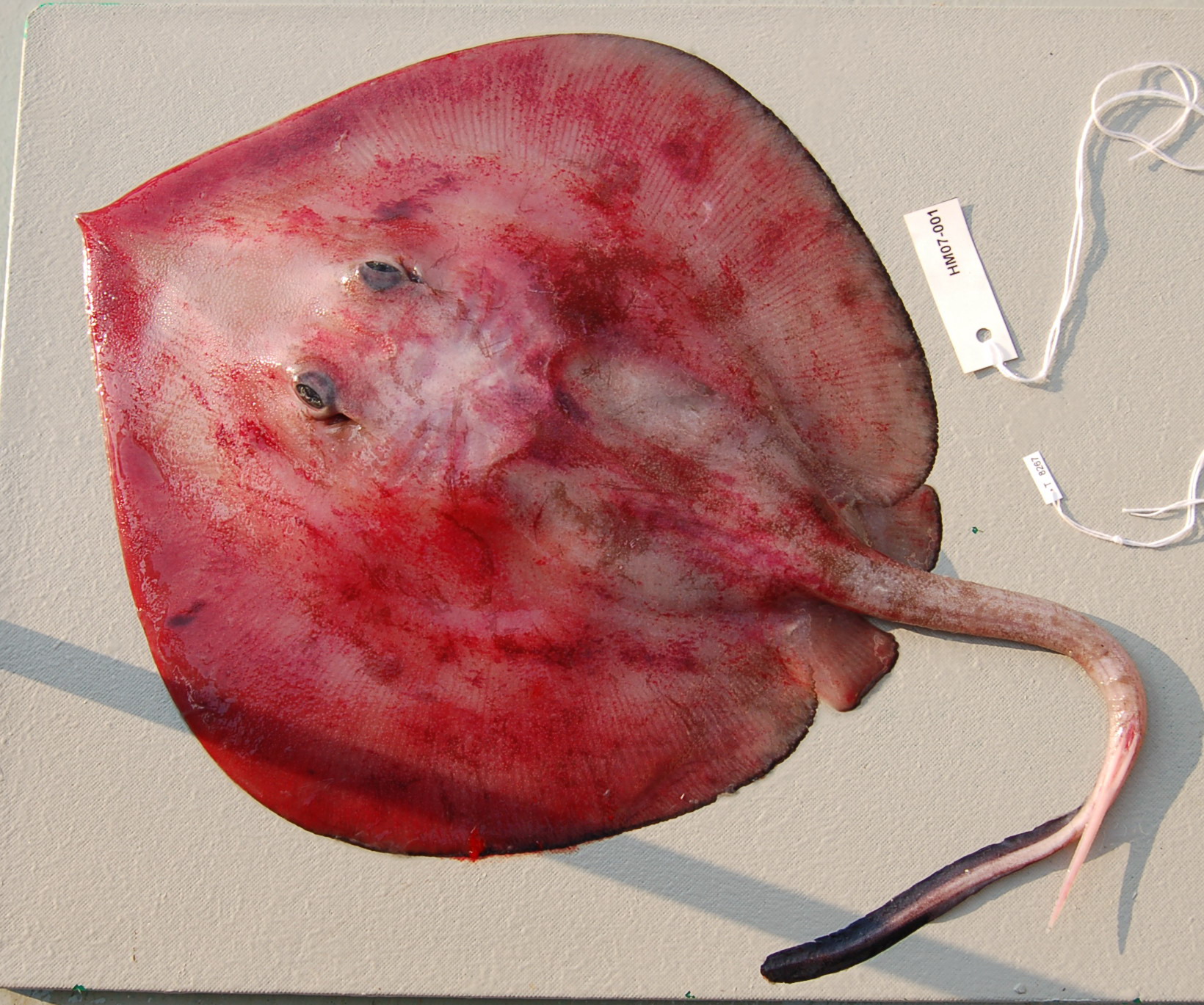
The Davies' sting ray (Plesiobatis daviesi) is a saltwater fish of the family Plesiobatidae that grows up to 270 cm.
Description
The deepwater stingray is a large stingray occurring worldwide in deep tropical waters. The species grows to about 2.7 metres and has an almost round, dark disc body and a fleshy tail with a serrated venomous spine. As a bottom-dweller it lives on the deep continental slope and eats crustaceans, molluscs and fish. The venomous spine can give a serious sting wound, though the chance of contact is small given its deep habitat. The IUCN assesses the species as Least Concern (LC).
Frequently asked questions
How do you recognise the Davies' sting ray?
The Davies' sting ray has an irregular in shape body, is mainly black and shows a plain pattern. Fleshy tail with a serrated venomous spine; deep-water bottom-dweller
Where does the Davies' sting ray live?
The Davies' sting ray lives in the sea (marine waters) and is mostly found around sand or mud bottom. Worldwide (deep sea)
How big does the Davies' sting ray get?
The Davies' sting ray grows to a maximum of about 270 cm.
Is the Davies' sting ray dangerous to humans?
The Davies' sting ray is venomous — handle spines with care and seek medical help after a sting if needed. The serrated tail spine is venomous. If stung: let it bleed, clean it and immerse 30-90 minutes in water as hot as tolerable (about 45 C); do not remove a spine lodged in chest or abdomen but call emergency services and always seek medical help.
Is the Davies' sting ray edible?
The Davies' sting ray is rarely eaten.
More photos


Want the complete picture on the Davies' sting ray?
Point your camera at the fish and Fin names the species in seconds. Free, and the Davies' sting ray is one of 12,519 species in the app.
All data
Identification
Appearance
Habitat & distribution
Behaviour & biology
For anglers
Safety
Status & sources
Want the complete picture on the Davies' sting ray?
Point your camera at the fish and Fin names the species in seconds. Free, and the Davies' sting ray is one of 12,519 species in the app.