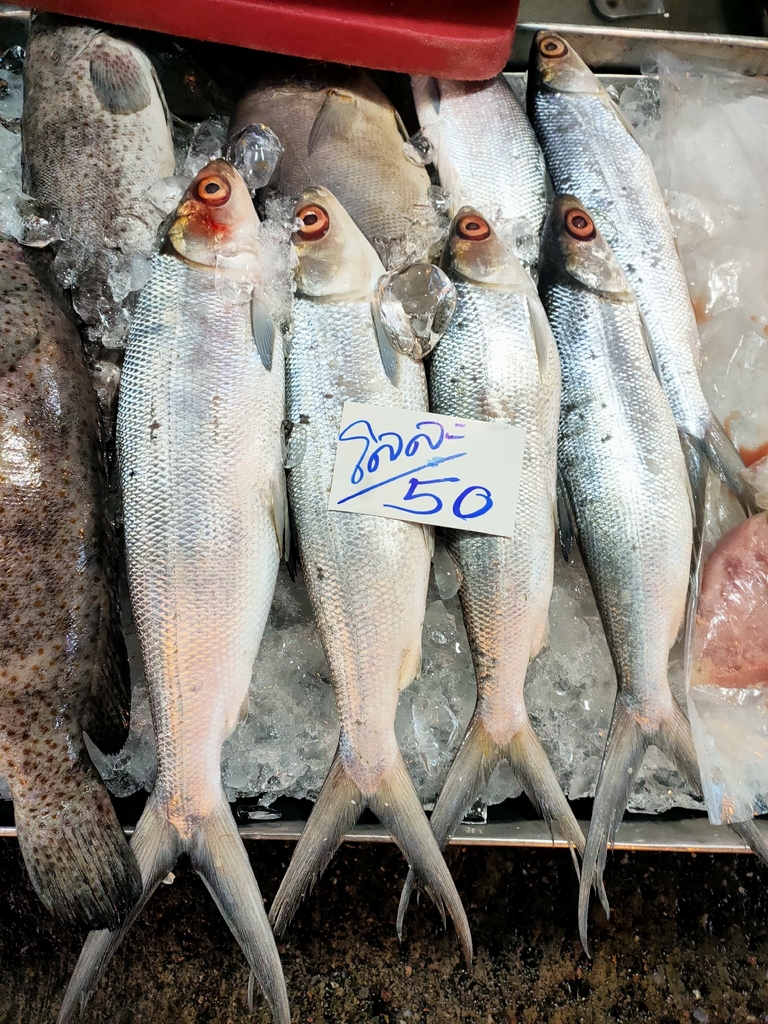
The Bangos (Chanos chanos) is a fish that lives in both fresh and salt water of the family Chanidae that grows up to 180 cm.
Description
The milkfish (Chanos chanos) is a large, silvery fish and the only species of the family Chanidae, widely distributed in the Indian and Pacific Oceans. The species has a streamlined, torpedo-shaped body with a deeply forked tail and can reach about 1.8 metres. Adults live in coastal seas and shallow bays, often enter estuaries and sometimes penetrate fresh water; they form schools near coasts and reefs. It is a peaceful plankton and algae feeder. The milkfish is one of the world's most important farmed fishes, especially in Southeast Asian aquaculture, and is widely eaten.
Frequently asked questions
How do you recognise the Bangos?
The Bangos has an elongate, eel-like body, is mainly silver-grey and shows a plain pattern.
Where does the Bangos live?
The Bangos lives in both fresh and salt water and is mostly found around mixed bottom.
How big does the Bangos get?
The Bangos grows to a maximum of about 180 cm. On average the species is around 100 cm.
Is the Bangos dangerous to humans?
No, the Bangos is harmless to humans.
Is the Bangos edible?
Yes, the Bangos is a highly prized food fish.
Download Fin's Fish Guide
Identify fish in seconds, log your catches and dives. Join the TestFlight beta.
All data
Identification
Appearance
Habitat & distribution
Behaviour & biology
For anglers
Safety
Status & sources
Download Fin's Fish Guide
Identify fish in seconds, log your catches and dives. Join the TestFlight beta.