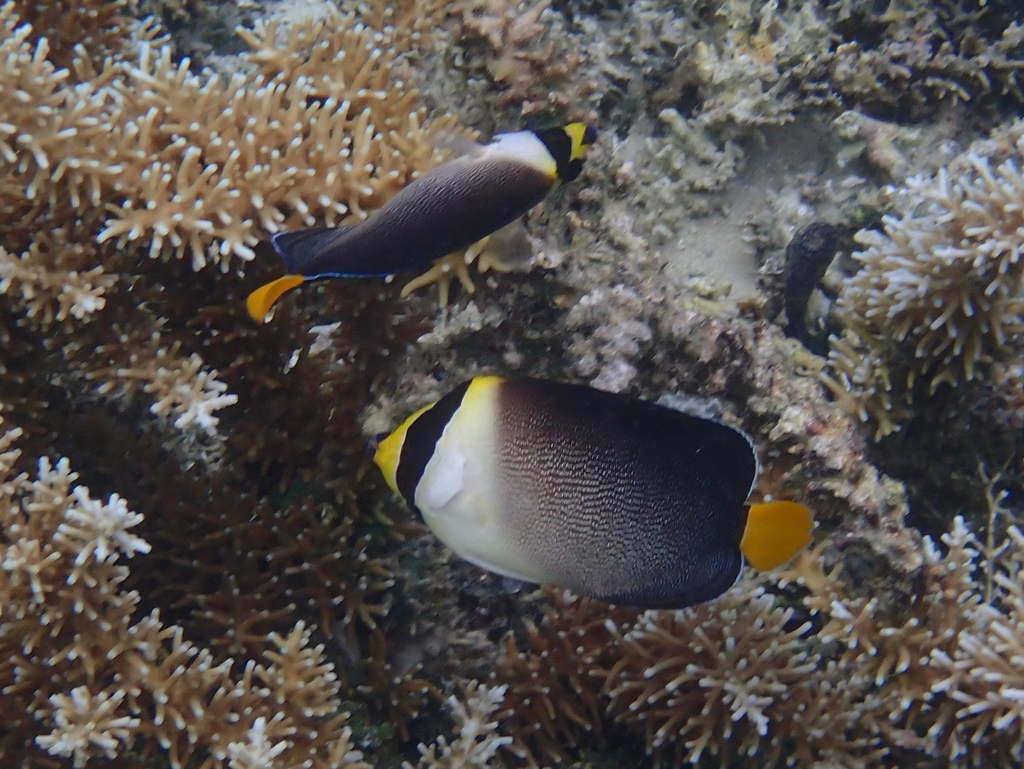
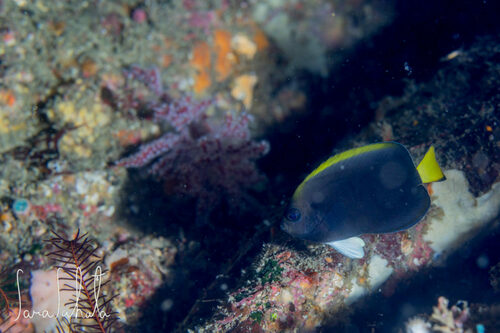
The Butterflyfish (Chaetodontoplus mesoleucus) is a saltwater fish of the family Pomacanthidae that grows up to 18 cm.
Description
The vermiculated angelfish is a small angelfish (Pomacanthidae) from the western Pacific. The species reaches about 18 cm and has a white front that grades into a dark body with a yellow tail and a black eye-band. It mainly inhabits continental shelf reefs and is rarely found around oceanic islands. The diet consists of sponges, tunicates and filamentous algae. The species forms small groups and is regularly exported through the aquarium trade. It closely resembles the related Chaetodontoplus poliourus, with which it co-occurs in a few places.
Frequently asked questions
How do you recognise the Butterflyfish?
The Butterflyfish has a flattened, disc-shaped body, is mainly white and shows a plain pattern.
Where does the Butterflyfish live?
The Butterflyfish lives in the sea (marine waters) and is mostly found around stony or rocky ground.
How big does the Butterflyfish get?
The Butterflyfish grows to a maximum of about 18 cm. On average the species is around 12 cm.
Is the Butterflyfish dangerous to humans?
No, the Butterflyfish is harmless to humans.
Is the Butterflyfish edible?
The Butterflyfish is rarely eaten.
Download Fin's Fish Guide
Identify fish in seconds, log your catches and dives. Join the TestFlight beta.
All data
Identification
Appearance
Habitat & distribution
Behaviour & biology
For anglers
Safety
Status & sources
Same genus Chaetodontoplus

More from the family Pomacanthidae
Download Fin's Fish Guide
Identify fish in seconds, log your catches and dives. Join the TestFlight beta.