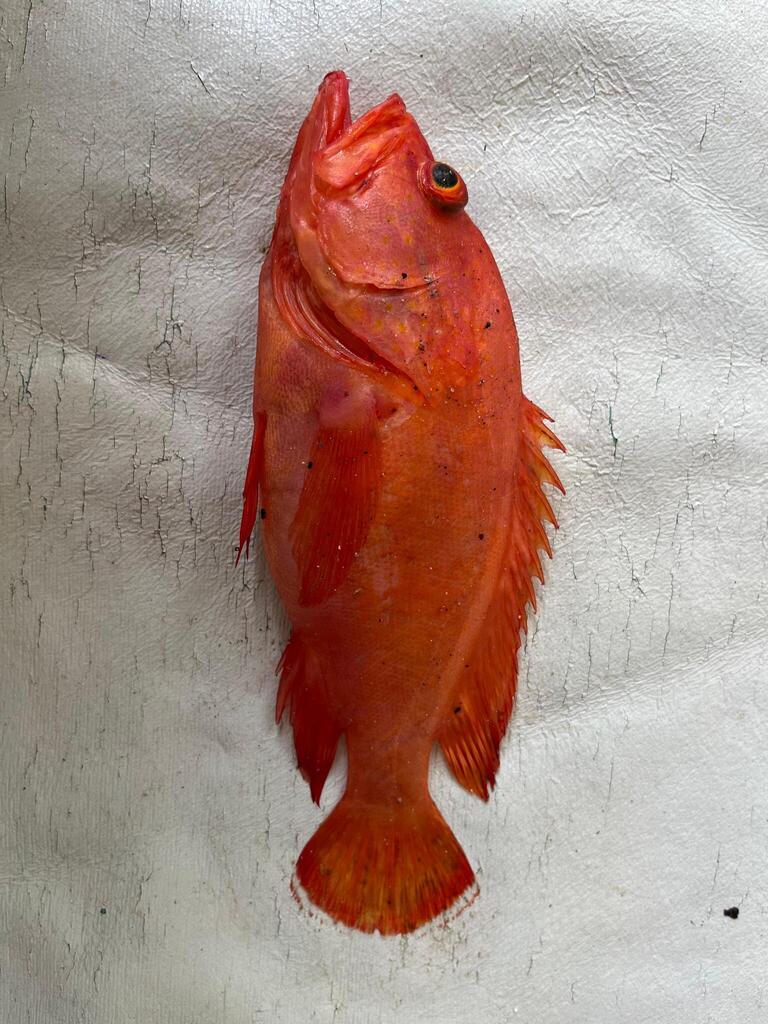
The Golden hind (Cephalopholis aurantia) is a saltwater fish of the family Serranidae that grows up to 60 cm.
Description
The golden hind is a rare grouper (Serranidae) from the Indo-West Pacific. The species reaches about 60 cm and has an orange-red, stocky body with a rounded tail. It lives on steep seaward reefs, usually at depths of 100 to 250 m but sometimes shallower, and is rarely seen. The diet consists mainly of crabs, supplemented with other crustaceans and small fishes. Like other groupers the species is a protogynous hermaphrodite, beginning as a female and later able to change into a male. Owing to the great depth it is little known.
Frequently asked questions
How do you recognise the Golden hind?
The Golden hind has a torpedo-shaped body, is mainly red-orange and shows a plain pattern.
Where does the Golden hind live?
The Golden hind lives in the sea (marine waters) and is mostly found around stony or rocky ground.
How big does the Golden hind get?
The Golden hind grows to a maximum of about 60 cm. On average the species is around 30 cm.
Is the Golden hind dangerous to humans?
No, the Golden hind is harmless to humans.
Is the Golden hind edible?
The Golden hind is rarely eaten.
Download Fin's Fish Guide
Identify fish in seconds, log your catches and dives. Join the TestFlight beta.
All data
Identification
Appearance
Habitat & distribution
Behaviour & biology
For anglers
Safety
Status & sources
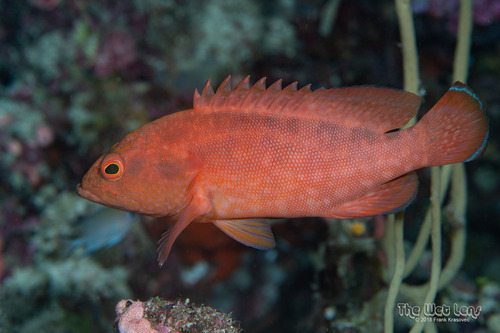
Same genus Cephalopholis
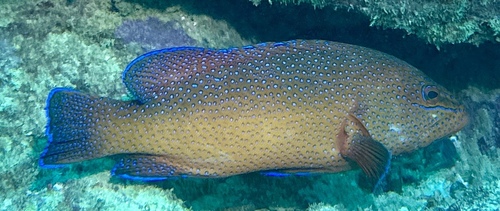
More from the family Serranidae


Download Fin's Fish Guide
Identify fish in seconds, log your catches and dives. Join the TestFlight beta.