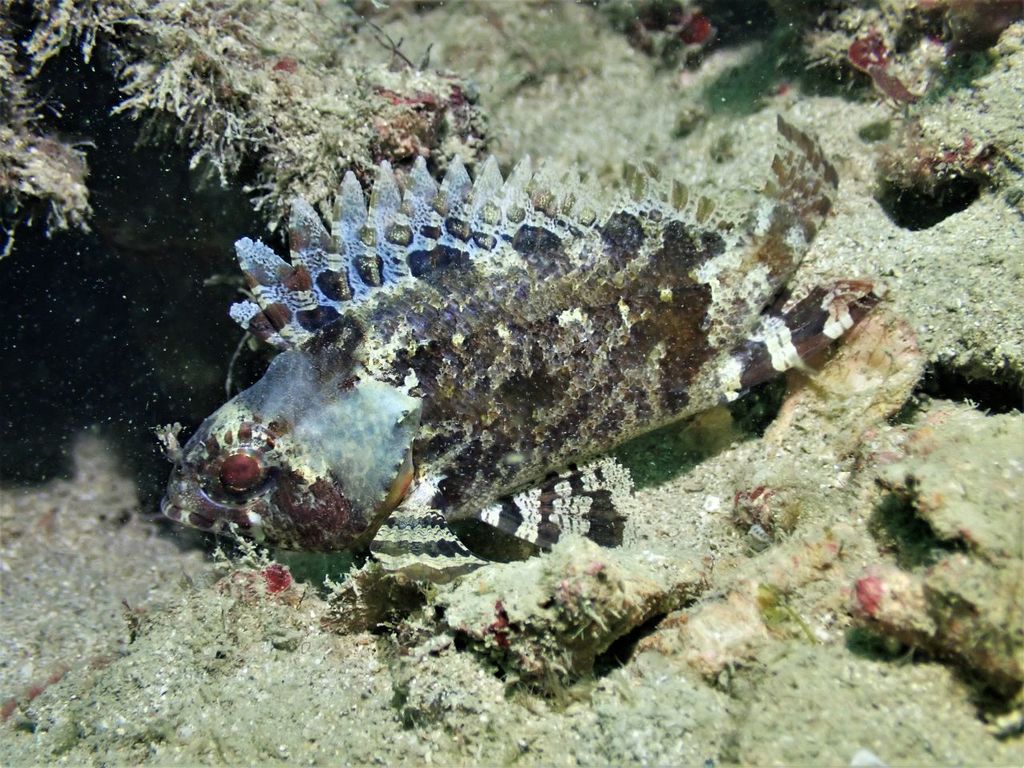
The False scorpionfish (Centrogenys vaigiensis) is a brackish-water fish of the family Centrogenyidae that grows up to 25 cm.
Description
The false scorpionfish is the only species of the family Centrogenyidae and occurs in the Indo-West Pacific. The species grows to about 25 cm and has a stocky, red-brown mottled body with a large, spiny head, strongly resembling the true, venomous scorpionfishes. That resemblance is a form of mimicry deterring predators, but unlike true scorpionfishes this species has no venom glands. It lives inshore on rocky reefs and rubble bottoms of shallow coastal waters. As an ambush predator it feeds on small fishes and crustaceans. The species is harmless to humans.
Frequently asked questions
How do you recognise the False scorpionfish?
The False scorpionfish has a torpedo-shaped body, is mainly red-orange and shows a marbled pattern.
Where does the False scorpionfish live?
The False scorpionfish lives in brackish water and is mostly found around mixed bottom.
How big does the False scorpionfish get?
The False scorpionfish grows to a maximum of about 25 cm. On average the species is around 9 cm.
Is the False scorpionfish dangerous to humans?
No, the False scorpionfish is harmless to humans.
Is the False scorpionfish edible?
The False scorpionfish is rarely eaten.
Download Fin's Fish Guide
Identify fish in seconds, log your catches and dives. Join the TestFlight beta.
All data
Identification
Appearance
Habitat & distribution
Behaviour & biology
For anglers
Safety
Status & sources
Download Fin's Fish Guide
Identify fish in seconds, log your catches and dives. Join the TestFlight beta.