 Fin's Fish Guide
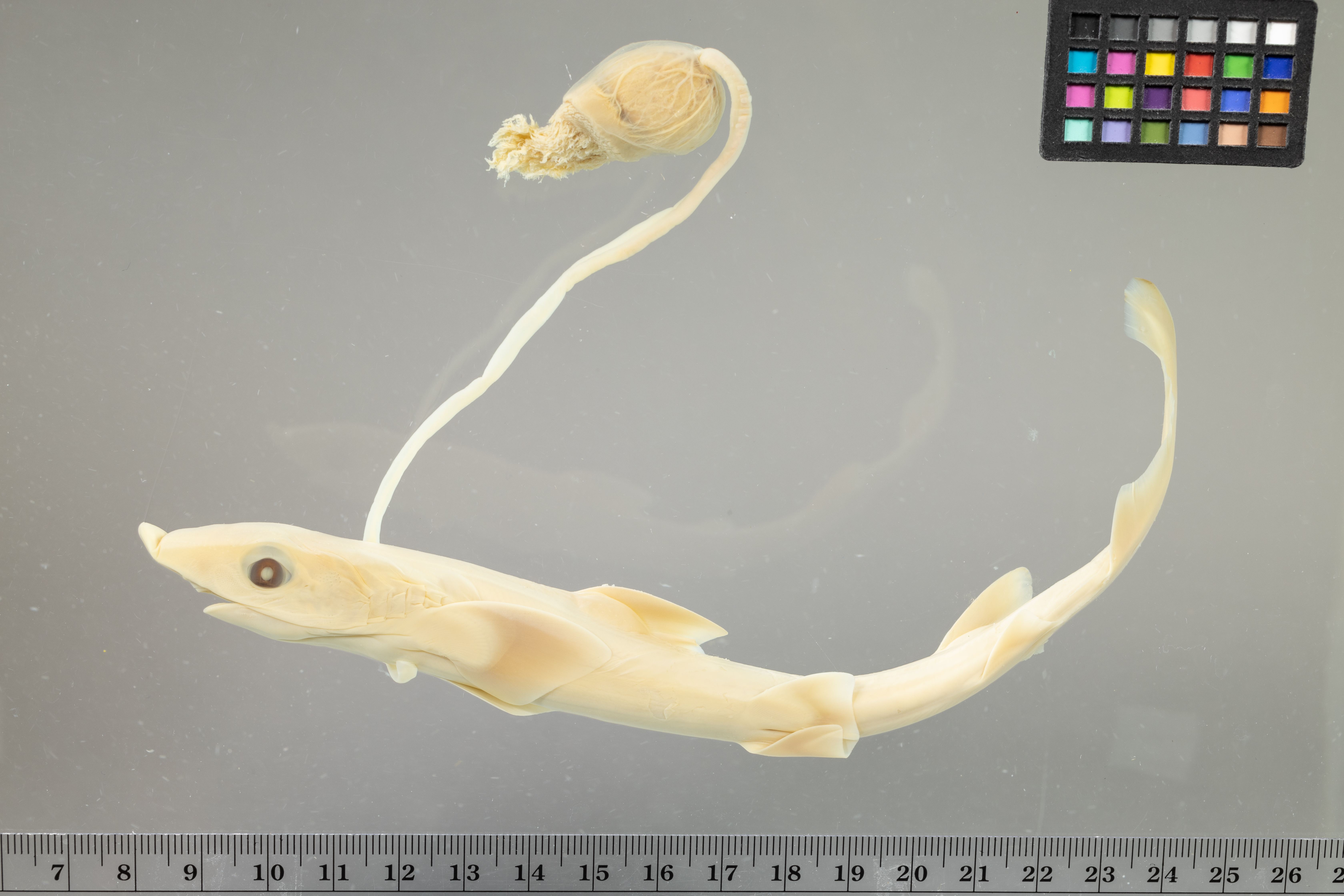
The Barbeled houndshark (Leptocharias smithii) is a brackish-water fish of the family Leptochariidae that grows up to 77 cm.
Eastern Atlantic along the coast of West Africa, in shallow coastal water and brackish estuaries, often near river mouths; tolerates brackish water.
Description
The barbeled houndshark is a slender coastal shark and the only species of the family Leptochariidae. It reaches about 80 cm long. The grey, streamlined body has large eyes and, uniquely for the region, a small barbel at each nostril, with which the shark probes the bottom. The species lives in shallow coastal water and brackish estuaries along the West African coast, often near river mouths, and tolerates brackish water. Close to the bottom it hunts crabs, shrimps, squid, worms and small fish. It is viviparous, with a small litter of young. Because it is heavily taken as bycatch and target catch and traded as food, it has declined and is assessed as Vulnerable (VU).
Frequently asked questions
How do you recognise the Barbeled houndshark?
The Barbeled houndshark has a torpedo-shaped body, is mainly silver-grey and shows a plain pattern. Slender coastal shark with a small barbel at each nostril and large eyes; the only shark with a true nasal barbel in this area.
Where does the Barbeled houndshark live?
The Barbeled houndshark lives in brackish water and is mostly found around sand or mud bottom. Eastern Atlantic along the coast of West Africa, in shallow coastal water and brackish estuaries, often near river mouths; tolerates brackish water.
How big does the Barbeled houndshark get?
The Barbeled houndshark grows to a maximum of about 77 cm. On average the species is around 55 cm.
Is the Barbeled houndshark dangerous to humans?
The Barbeled houndshark can bite, but is otherwise not dangerous to humans. Not venomous, but a predatory shark with sharp teeth: keep your distance from a hooked or landed shark and handle only with proper equipment.
Is the Barbeled houndshark edible?
Yes, the Barbeled houndshark is commonly eaten.
More photos


Want the complete picture on the Barbeled houndshark?
Point your camera at the fish and Fin names the species in seconds. Free, and the Barbeled houndshark is one of 12,519 species in the app.
All data
Identification
Appearance
Habitat & distribution
Behaviour & biology
For anglers
Safety
Status & sources
Want the complete picture on the Barbeled houndshark?
Point your camera at the fish and Fin names the species in seconds. Free, and the Barbeled houndshark is one of 12,519 species in the app.