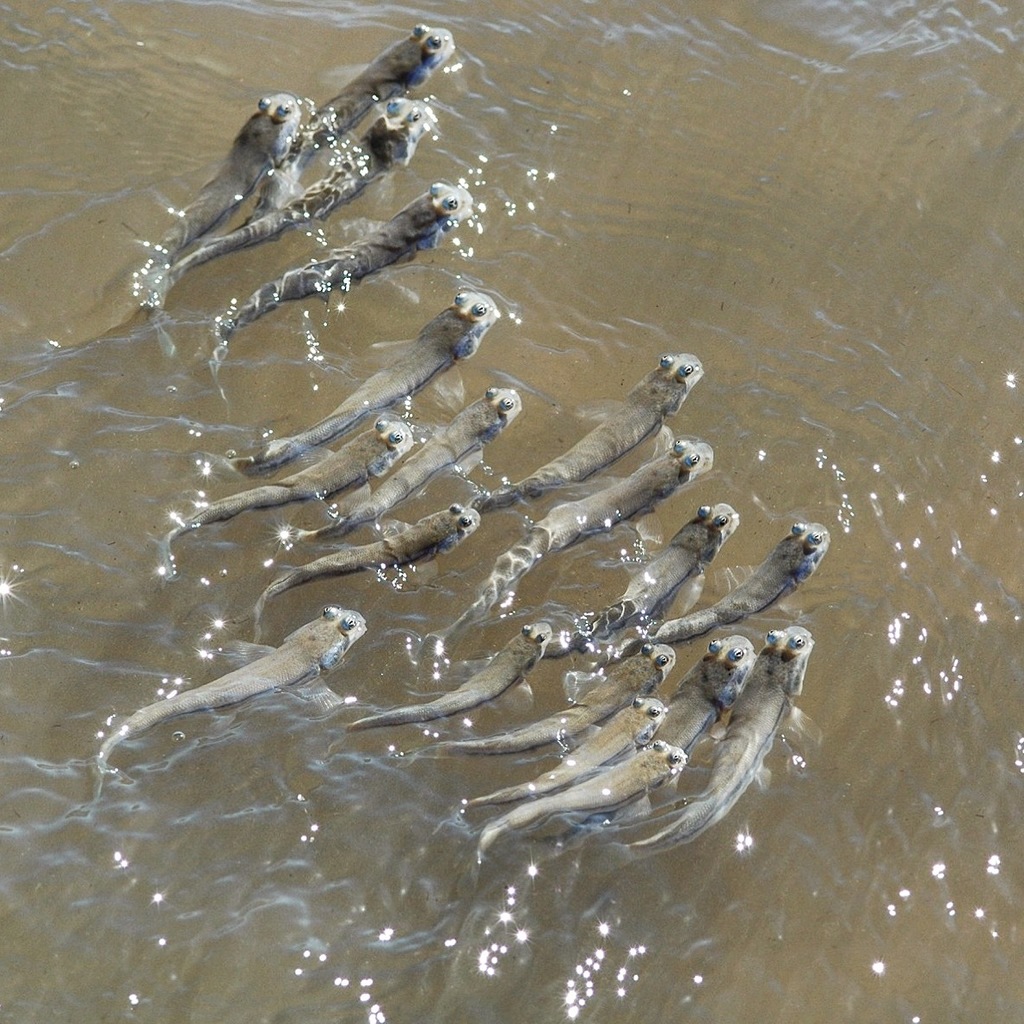
The Foureye (Anableps anableps) is a brackish-water fish of the family Anablepidae that grows up to 30 cm.
Description
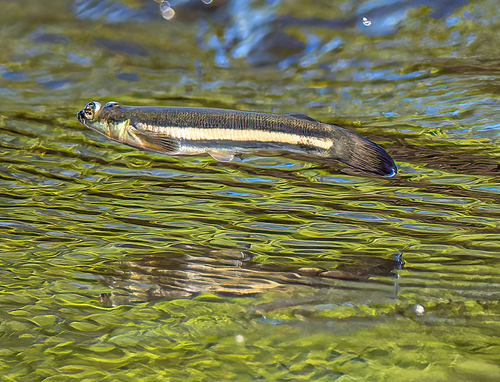
The largescale four-eyed fish (Anableps anableps) is a striking fish of the family Anablepidae inhabiting coastal and brackish areas of northern South America. The species owes its name to its remarkable eyes: each eye is horizontally divided in two, so the fish can see above and below the water surface at the same time while swimming just below the surface. It lives mainly in fresh and brackish water along mangroves and lagoons, moves in schools and can remain on exposed mud at low tide. The diet consists of insects, other invertebrates, mud-dwelling diatoms and small fishes. The species is livebearing.
Frequently asked questions
How do you recognise the Foureye?
The Foureye has an elongate, eel-like body, is mainly silver-grey and shows a horizontal stripes pattern.
Where does the Foureye live?
The Foureye lives in brackish water and is mostly found around sand or mud bottom.
How big does the Foureye get?
The Foureye grows to a maximum of about 30 cm. On average the species is around 14 cm.
Is the Foureye dangerous to humans?
No, the Foureye is harmless to humans.
Is the Foureye edible?
Yes, the Foureye is commonly eaten.
Download Fin's Fish Guide
Identify fish in seconds, log your catches and dives. Join the TestFlight beta.
All data
Identification
Appearance
Habitat & distribution
Behaviour & biology
For anglers
Safety
Status & sources
Same genus Anableps
More from the family Anablepidae
Download Fin's Fish Guide
Identify fish in seconds, log your catches and dives. Join the TestFlight beta.