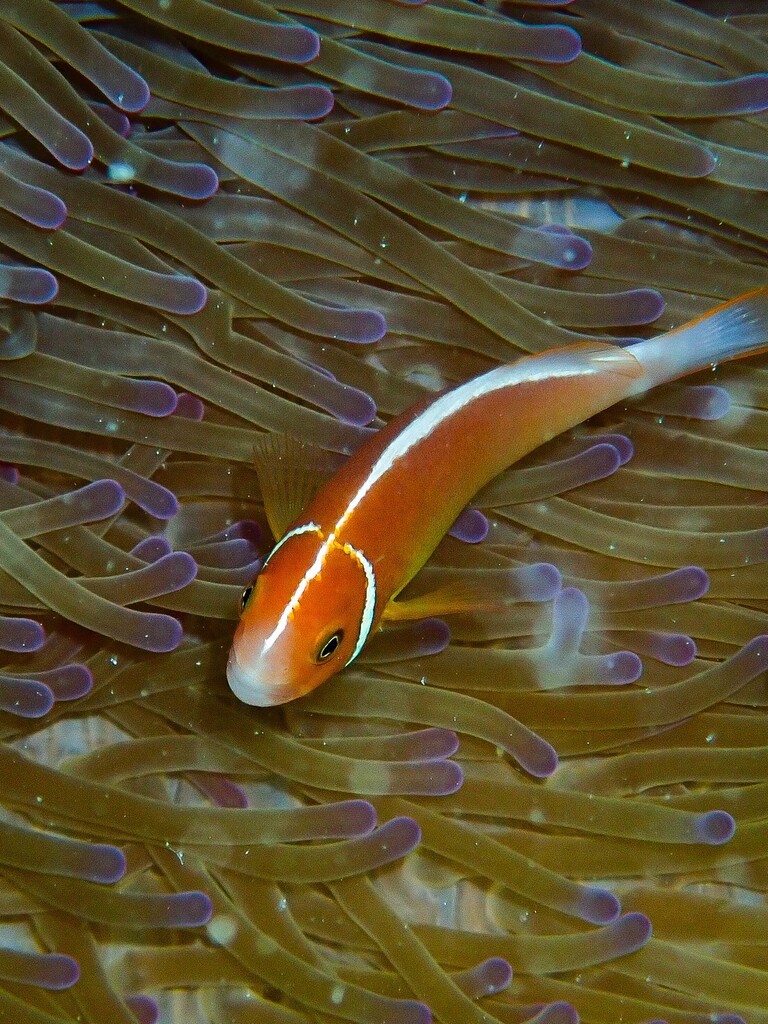
The Clown fish (Amphiprion perideraion) is a brackish-water fish of the family Pomacentridae that grows up to 10 cm.
Description
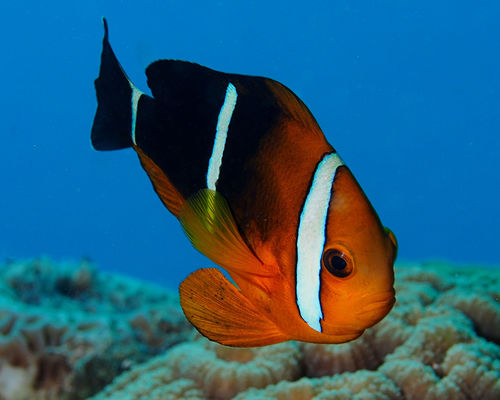
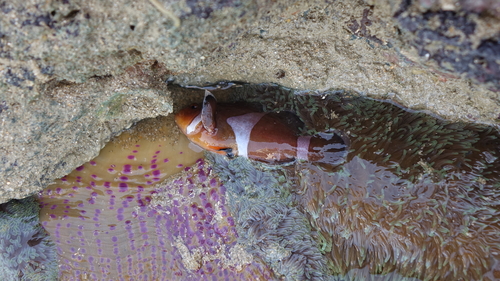
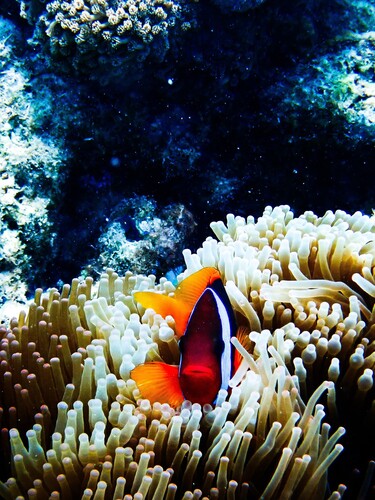
The pink anemonefish is a damselfish (Pomacentridae) from the western Pacific. The species has a pink to orange body with a white stripe along the back and a white band behind the head. It lives in symbiosis with large sea anemones, among which it finds shelter; a mucus layer protects it from the stinging cells. It lives in small, monogamous groups with a dominant female. As a protandrous hermaphrodite each fish starts as a male and can change into a female. It feeds on algae and small zooplankton. The species is harmless to humans.
Frequently asked questions
How do you recognise the Clown fish?
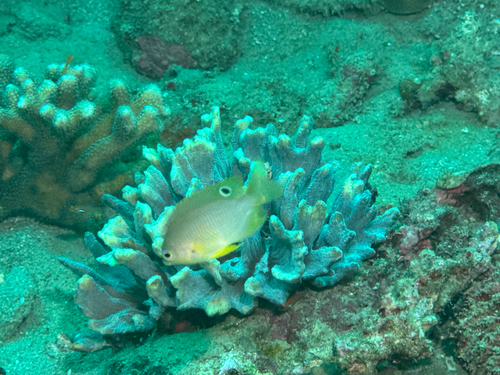
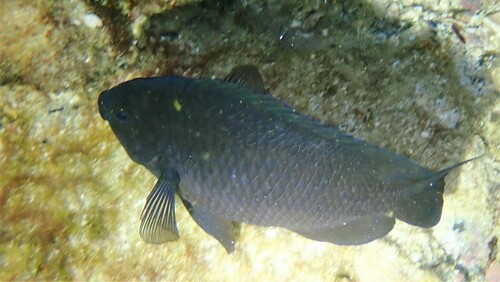
The Clown fish has a flattened, disc-shaped body, is mainly pink-purple and shows a plain pattern.
Where does the Clown fish live?
The Clown fish lives in brackish water and is mostly found around stony or rocky ground.
How big does the Clown fish get?
The Clown fish grows to a maximum of about 10 cm.
Is the Clown fish dangerous to humans?
No, the Clown fish is harmless to humans.
Is the Clown fish edible?
The Clown fish is not usually eaten.
Download Fin's Fish Guide
Identify fish in seconds, log your catches and dives. Join the TestFlight beta.
All data
Identification
Appearance
Habitat & distribution
Behaviour & biology
For anglers
Safety
Status & sources
Same genus Amphiprion
More from the family Pomacentridae
Download Fin's Fish Guide
Identify fish in seconds, log your catches and dives. Join the TestFlight beta.