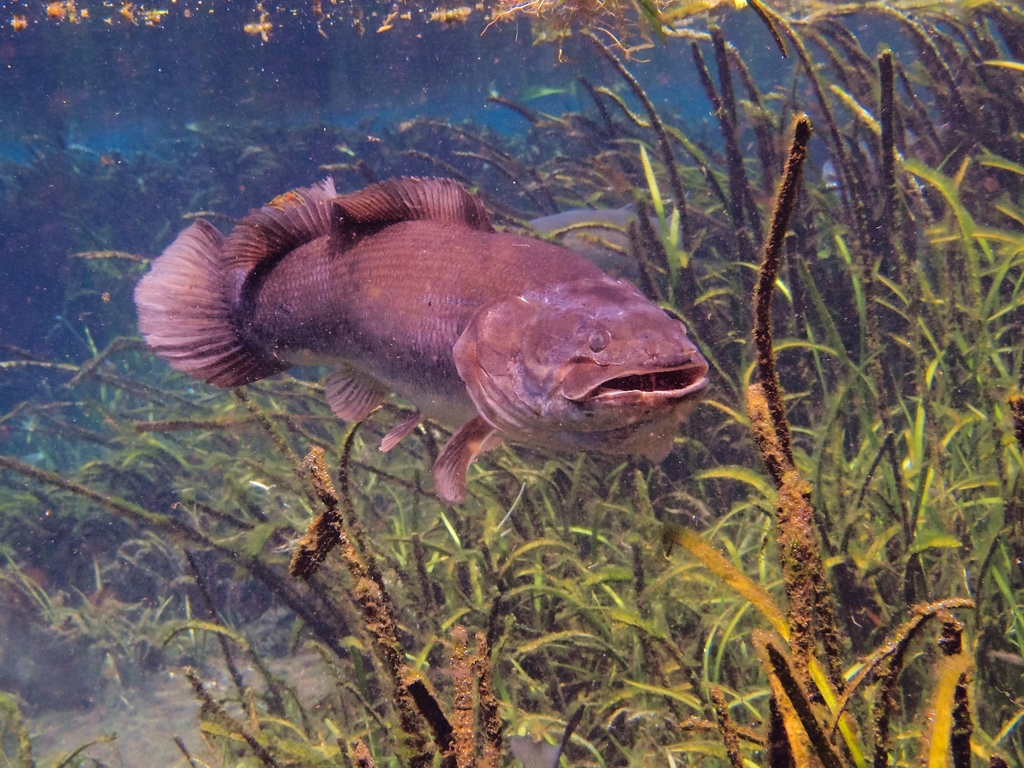
The Bowfin (Amia calva) is a freshwater fish of the family Amiidae that grows up to 109 cm.
Description
The bowfin is an archaic predator of the family Amiidae and the only surviving species of a very ancient fish group; it reaches about 1.1 metres. The cylindrical, brown-marbled body has a very long, undulating dorsal fin, a bony, hard head and a gas bladder that works as a primitive lung, so it can gulp air in oxygen-poor water. The male has a conspicuous, yellow-ringed eyespot on the tail base. The species comes from eastern North America and lives in slow, densely vegetated water of swamps, lakes and rivers. As an ambush predator it pounces on fish, crustaceans, frogs and insects. The male builds a nest and fiercely guards the dense black school of young. It bites hard when handled.
Frequently asked questions
How do you recognise the Bowfin?
The Bowfin has a torpedo-shaped body, is mainly brown and shows a marbled pattern.
Where does the Bowfin live?
The Bowfin lives in fresh water and is mostly found around algae or seagrass beds.
How big does the Bowfin get?
The Bowfin grows to a maximum of about 109 cm. On average the species is around 53 cm.
Is the Bowfin dangerous to humans?
The Bowfin can bite, but is otherwise not dangerous to humans.
Is the Bowfin edible?
Yes, the Bowfin is commonly eaten.
Download Fin's Fish Guide
Identify fish in seconds, log your catches and dives. Join the TestFlight beta.
All data
Identification
Appearance
Habitat & distribution
Behaviour & biology
For anglers
Safety
Status & sources
Download Fin's Fish Guide
Identify fish in seconds, log your catches and dives. Join the TestFlight beta.