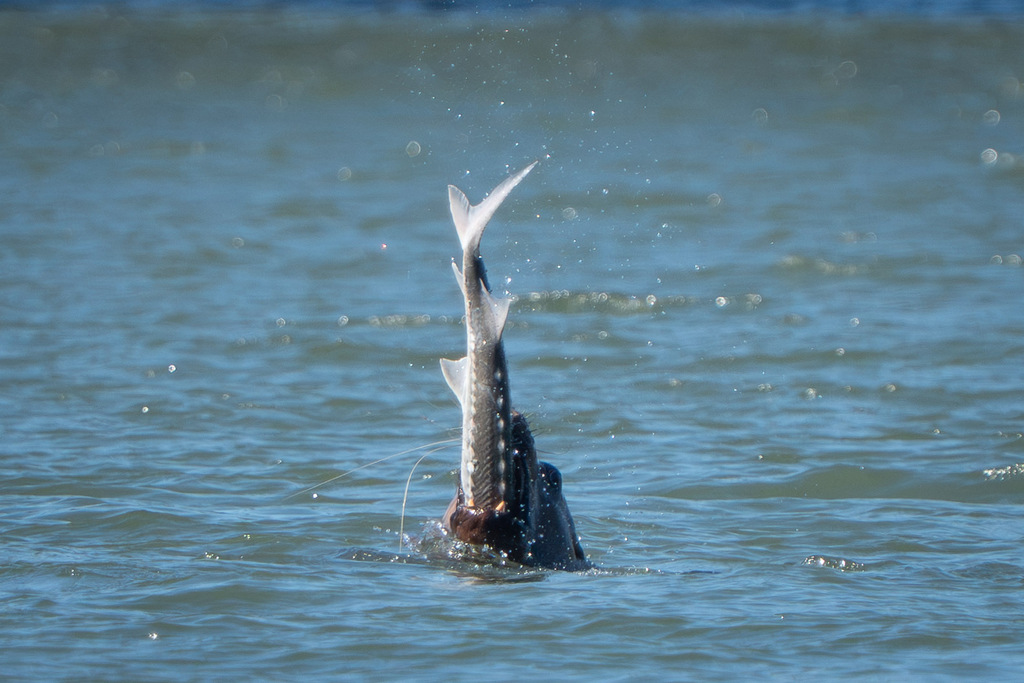
The Columbia sturgeon (Acipenser transmontanus) is a fish that lives in both fresh and salt water of the family Acipenseridae that grows up to 610 cm.
Description
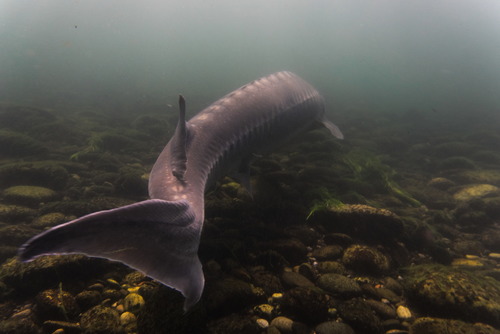
The white sturgeon is one of North America's largest freshwater fishes and occurs along the Pacific coast from Alaska to California. The species has an elongate, grey body with rows of bony plates (scutes) and bears barbels beneath the pointed snout above a downward-facing, protrusible mouth. Exceptional individuals reach six metres and over a hundred years of age. The fish is anadromous: it lives largely in the sea and coastal waters and migrates far up rivers to spawn. It feeds on fishes and bottom animals. The species yields meat and caviar.
Frequently asked questions
How do you recognise the Columbia sturgeon?
The Columbia sturgeon has an elongate, eel-like body, is mainly silver-grey and shows a plain pattern.
Where does the Columbia sturgeon live?
The Columbia sturgeon lives in both fresh and salt water and is mostly found around sand or mud bottom.
How big does the Columbia sturgeon get?
The Columbia sturgeon grows to a maximum of about 610 cm. On average the species is around 21 cm.
Is the Columbia sturgeon dangerous to humans?
No, the Columbia sturgeon is harmless to humans.
Is the Columbia sturgeon edible?
Yes, the Columbia sturgeon is commonly eaten.
Download Fin's Fish Guide
Identify fish in seconds, log your catches and dives. Join the TestFlight beta.
All data
Identification
Appearance
Habitat & distribution
Behaviour & biology
For anglers
Safety
Status & sources
Same genus Acipenser



More from the family Acipenseridae
Download Fin's Fish Guide
Identify fish in seconds, log your catches and dives. Join the TestFlight beta.